

If you run a service business, you didn’t start it so you could spend 20 to 30 hours a week trapped behind a screen managing admin chaos, chasing unreturned phone calls, or copying data between spreadsheets.
You built a business to do high-impact work, deliver results for your clients, and generate sustainable profit. Yet, for most owners of skilled trade contracting companies, home service businesses, and healthcare or allied health practices, the operational burden of daily management acts as a hard ceiling on growth.
The common belief is that adopting Artificial Intelligence (AI) to automate business operations requires a computer science degree, expensive software engineering consultants, or months of technical setup.
That belief is false.
Today, AI tools have matured to the point where non-technical founders can easily delegate repetitive, time-consuming operational tasks. By setting up simple AI workflows—or utilizing pre-built AI agents—you can plug profit leaks, improve client responsiveness, and reclaim your time immediately.
7 High-ROI Tasks You Can Hand Off To AI
1. 24/7 Inbound Lead Qualification and Call Handling
The Problem
Every missed call in a service business is a lost contract. When a prospect with an urgent need—like a leaking roof or a broken HVAC unit—calls your business and hits voicemail, they rarely leave a message. Instead, they hang up and dial your nearest competitor.
Relying on human staff to answer every call 24 hours a day, 7 days a week is financially impractical for most small businesses.
The AI Solution
Modern Voice AI agents and intelligent web chat assistants can handle multi-channel inbound communication seamlessly. These AI agents do far more than play a static greeting; they conduct natural, human-sounding conversations.
They ask diagnostic questions, qualify the prospect based on your ideal customer criteria, collect contact details, and automatically schedule discovery calls or service appointments directly into your calendar software (such as Google Calendar, ServiceTitan, or Jobber).
Implementation (No Tech Skills Needed)
- Pre-built Voice Agents: Platforms now offer turn-key voice AI solutions where you simply upload a basic script or document detailing your pricing guidelines, service area, and scheduling availability.
- Smart Phone Forwarding: Set up call forwarding on your existing phone line so that missed calls, after-hours calls, or line-busy calls automatically route to your AI assistant.
2. Automated Post-Appointment Follow-Ups and Review Generation
The Problem
Consistently following up with leads after sending a quote or requesting reviews after completing a job is vital for maintaining a high closing rate and building local online authority. However, manually drafting personalized emails and texts for every customer is one of the first tasks to fall through the cracks when your business gets busy.
The AI Solution
Generative AI tools paired with standard automated messaging triggers allow you to deliver timely, hyper-personalized follow-ups. Rather than sending generic, robotic templates that get ignored, AI reads the customer’s job notes, invoice details, or project summary and crafts a natural, personalized message.
If a client had a specific concern or selected a particular product tier during their service, the AI tailors the message to mention those exact details, dramatically improving engagement and review conversion rates.
Implementation (No Tech Skills Needed)
- Use no-code automation platforms like Make or Zapier to connect your CRM or invoicing software directly to an AI messaging tool.
- Define simple rules: When a job status changes to “Completed,” prompt AI to generate a personalized thank-you message and review request.
3. First-Draft Proposal and Quote Generation
The Problem
Creating detailed, professional quotes and proposals can take hours. Service providers often delay sending quotes because they are stuck on job sites all day, giving prospective clients time to look elsewhere or lose interest.
The AI Solution
AI can instantly transform rough job notes, voice memos, or intake form data into polished, professional proposals. By supplying an AI model with your standardized price lists, scope options, and company terms, the tool can draft a fully structured proposal complete with executive summaries, scope of work breakdowns, and customized upsell options in seconds.
Implementation (No Tech Skills Needed)
- Voice-to-Text Input: Use a smartphone voice recorder to dictate your raw job site notes (e.g., “Client needs a 2,000 sq ft roof replacement, architectural shingles, replacing two skylights, job site accessible via driveway”).
- AI Formatting: Feed that recording into an AI platform instructed to format the notes into your standard company proposal layout. All you have to do is review, make any necessary adjustments, and hit send.
4. Local SEO Content and GEO Optimization Drafts
The Problem
To attract consistent inbound leads, your service business must be visible where customers are searching. Today, visibility isn’t just about traditional Google Search results; it’s also about Generative Engine Optimization (GEO).
Modern search platforms and AI assistants (like ChatGPT, Claude, Perplexity, and Google Gemini) serve as answer engines for local consumers asking questions like “Who is the best commercial electrician near me?”
Creating authoritative content that answers these specific local questions consistently takes time that most owners do not have.
The AI Solution
AI tools excel at researching local search intent, structuring service-area pages, and generating informative blog content tailored for both human readers and AI recommendation engines. AI can generate clear, direct answers to common customer questions, incorporate structured data points, and outline local case studies that establish your brand as the leading authority in your service area.
Implementation (No Tech Skills Needed)
- Content Generation: Prompt an AI assistant with a specific client question you handle frequently (e.g., “Explain how to spot early signs of commercial roof failure in humid climates”).
- GEO Structuring: Ask the AI to structure the content with direct, summary-first answers, bulleted feature comparisons, and clear service details so search engines and AI engines can read and index the information easily.
5. Customer Service Email Triage and Response Drafting
The Problem
The average business owner spends hours each day sorting through an overflowing email inbox containing a mix of urgent client requests, vendor invoices, spam, routine status updates, and new sales inquiries. Context-switching between these different communication streams drains mental energy and causes slow response times on high-priority inquiries.
The AI Solution
AI email assistants can continuously monitor your inbox, categorize incoming messages by urgency and topic, and automatically draft context-aware replies for your review. When an existing client emails to ask for a status update, the AI cross-references your internal tracking notes or job board and drafts a clear, professional response.
Implementation (No Tech Skills Needed)
- Inbox Integration: Enable built-in AI email assistants within tools like Gmail or Outlook, or utilize simple no-code extensions designed for inbox management.
- Drafting Workflow: Configure the AI to save its suggested responses in your “Drafts” folder rather than sending them automatically. This allows you to quickly skim, approve, or adjust messages in minutes instead of typing every response from scratch.
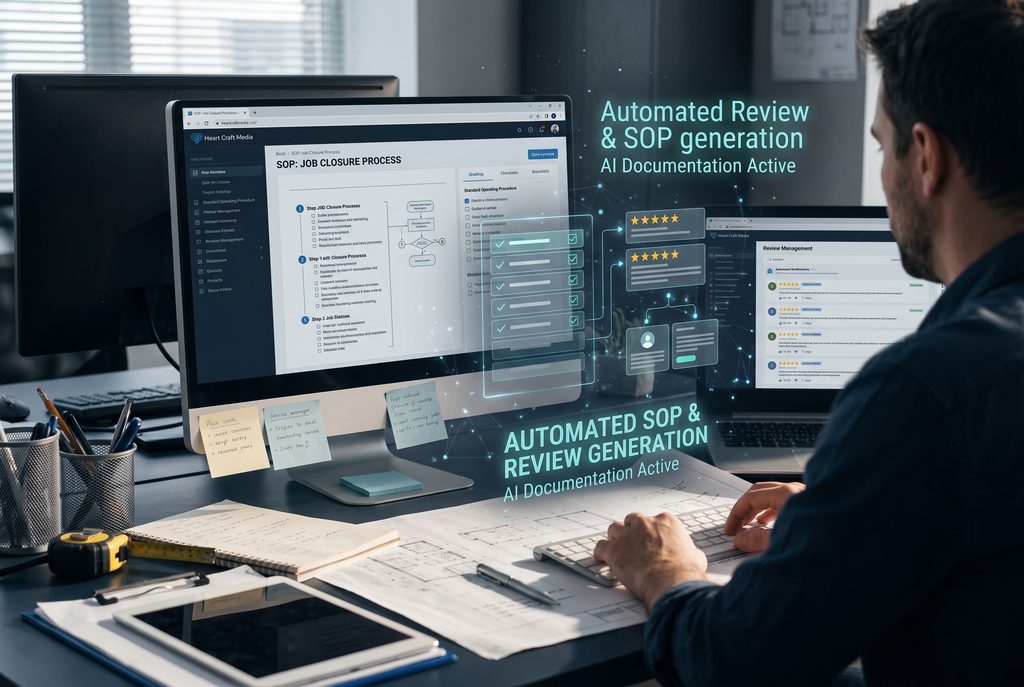
6. Standard Operating Procedure (SOP) Creation
The Problem
If your business relies entirely on the information stored inside your head, you cannot scale. True operational freedom requires well-documented Standard Operating Procedures (SOPs) so your team can execute tasks consistently without needing your constant oversight.
However, sitting down to type out step-by-step instruction manuals for every workflow in your company is a daunting, tedious task that often gets postponed indefinitely.
The AI Solution
AI dramatically speeds up process documentation. By recording yourself performing a task or verbally describing a workflow on screen, AI can transcribe the audio, identify the key operational steps, eliminate filler words, and format the information into a clean, searchable SOP document complete with checklists and troubleshooting guidelines.
Implementation (No Tech Skills Needed)
- Record the Workflow: Use a free screen recording tool (like Loom) or a simple voice recorder to document how a process is completed (e.g., how to handle an incoming warranty claim or reconcile weekly receipts).
- AI Transformation: Run the video or audio transcript through an AI assistant with the instruction: “Turn this transcript into a step-by-step Standard Operating Procedure with a summary, prerequisite checklist, numbered action steps, and common FAQs.”
7. Weekly Operational Data Summaries and Profit Leak Detection
The Problem
Small service businesses frequently leak profit through small, unmonitored operational gaps: unbilled overtime, untracked job materials, uncollected invoices, or sudden drops in lead conversion rates. Reviewing complex spreadsheets and financial reports to spot these trends requires time and analytical energy that many owners lack at the end of a busy week.
The AI Solution
Modern AI tools function as on-demand operational analysts. You can securely upload raw data exports—such as job costing reports, weekly schedules, or revenue spreadsheets—and ask the AI to perform a quick forensic review.
The AI can identify anomalies, highlight declining conversion rates, highlight overdue invoices, and generate a concise executive summary detailing exactly where your operations are losing efficiency.
Implementation (No Tech Skills Needed)
- Data Export: Export your weekly operational summary or transaction report as a simple CSV file or spreadsheet.
- Prompt the Analysis: Upload the document to a secure AI analysis tool and ask targeted questions:
- “What were our top three largest unexpected expenses this week?”
- “Identify any recurring jobs where actual labor hours exceeded our initial estimate by more than 15%.”
- “Summarize our outstanding invoices into 30, 60, and 90+ day categories.”
Summary: How to Get Started This Week

You do not need to overhaul your entire business infrastructure overnight to benefit from artificial intelligence. Trying to automate every workflow at once often leads to unnecessary complexity and frustration.
Instead, follow a simple three-step approach:
- Identify Your Biggest Operational Bottleneck: Look at the 7 tasks above and select the single area causing the most friction, lost revenue, or wasted administrative time in your business right now.
- Implement One Simple Solution: Pick a no-code tool or dedicated service to handle that single task. Give it 7 to 14 days to run and evaluate the time saved.
- Reinvest the Time Saved: Use the hours you reclaim to focus on strategic growth, high-value client relationships, or fixing the next operational efficiency gap.
By leveraging AI to handle repetitive administrative workloads, you transition your business away from owner dependency and toward a scalable, predictable operational model.
Need Help Eliminating Operational Chaos in Your Business?
At Heart Craft Media, we help service-based businesses, skilled trade contractors, and healthcare practices stop leaking profit and build scalable systems. Whether you need custom AI phone and chat agents, simple workflow automations, or full strategic leadership through our Fractional COO services, we install the systems that let you scale without the burnout.
👉 Book Your Free 30-Minute Operations Audit Today to uncover where your business is losing time and money—and get a clear roadmap to fix it.