

For most service business owners, the weekly team meeting feels like an exercise in controlled chaos.
You sit down with your key team members field managers, dispatchers, sales leads, or administrative heads and within five minutes, the meeting derailment begins. Someone brings up a single unhappy client, and the entire team spends twenty minutes debating customer service policies. Someone else starts venting about supplier delays. Before you know it, an hour has evaporated, no clear decisions have been made, and everyone returns to their desks with a fresh list of grievances instead of a concrete action plan.
When weekly meetings devolve into unstructured talking shop, two dangerous operational breakdowns occur:
- The owner remains the operational bottleneck. Without a structured forum to resolve systemic issues, every minor daily decision gets kicked back upstairs to the business owner.
- Team members lose accountability. When metrics aren’t tracked systematically and commitments aren’t reviewed weekly, priority tasks drift from week to week without completion.
If your weekly operations meeting feels like a waste of time, the problem isn’t the concept of meeting it’s the absence of a strict, execution-focused agenda.
Here is the exact 30-minute weekly operations meeting framework designed to keep your service business aligned, eliminate profit leaks, and give your leadership team total operational clarity.
The Anatomy of an Effective Operations Meeting
A successful weekly operations meeting is not a brain-storming session, a sales pitch, or a therapy group. It is an operational sync designed to measure performance, identify bottlenecks, and assign single-point accountability.
To make a 30-minute meeting work, you must enforce three cardinal rules:
- Same Day, Same Time, Same Agenda: Treat this time slot as unmovable. Whether you run a roofing company, a medical spa, or an IT consultancy, consistency builds operational rhythm.
- Metrics Before Feelings: Start every meeting with hard numbers (Key Performance Indicators), not subjective opinions about how the week “felt.”
- Identify, Discuss, Solve (IDS): Do not spend meeting time complaining about a problem without assigning an owner and a deadline to resolve it.
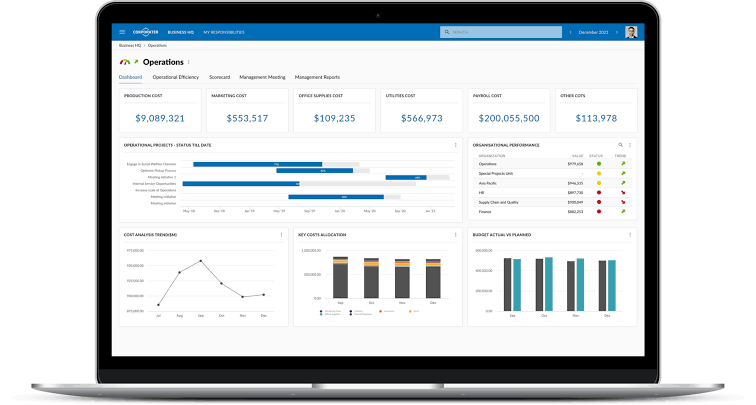
A clear operational dashboard helps track scorecard metrics, budgets, and project statuses during your 30-minute meeting.. Source: Corporater
The 30-Minute Agenda Breakdown
To execute a tight, high-impact weekly operations meeting, divide your 30 minutes into four distinct, timed blocks:
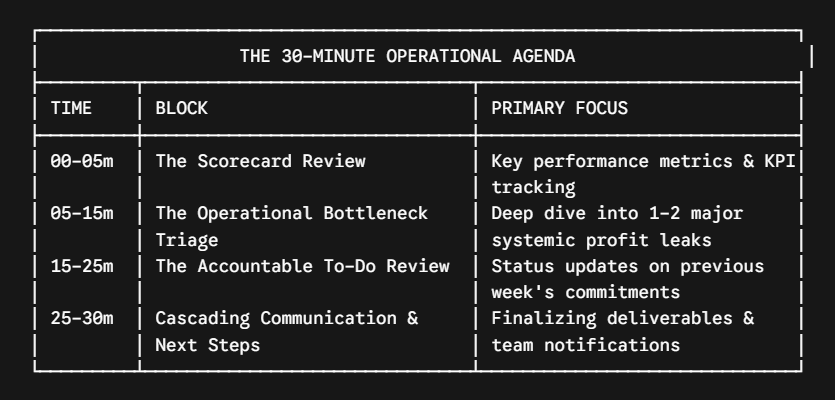
Block 1: The Scorecard Review (5 Minutes)
Every service business operates on 4 to 6 critical numbers that dictate operational health. The meeting opens with the scorecard owner reading the numbers aloud. There is no commentary or story attached yet—just the metrics versus targets.
Key metrics to track weekly:
- Unbooked Leads: How many calls/inquiries came in versus booked appointments?
- Average Ticket / Close Rate: Are sales numbers tracking to target?
- Capacity Utilization: What percentage of billable hours or job slots are filled for the upcoming week?
- Gross Profit Margin per Job: Are job costs (labor + materials) staying within budget?
- Outstanding Receivables: What dollar amount is stuck in uncollected invoices past 30 days?
If a metric is on target, move immediately to the next one. If a metric is off target, add it to the Bottleneck Triage list without debating it yet.
Block 2: Operational Bottleneck Triage (10 Minutes)
This is the heart of the meeting. Take the 1 or 2 biggest operational friction points identified from your scorecard or recent job logs and address them directly.
Instead of talking in circles, use the Root-Cause Framework:
- Name the Systemic Failure: Never blame an individual person first. Ask: Which internal workflow, SOP, or automation failed here?
- Quantify the Dollar Leak: Put an exact financial figure on the issue. (e.g., “Missed follow-ups on unbooked leads cost us $8,000 in revenue last week.”)
- Decide the Fix: Assign a specific team member to fix the workflow or update the process by the next meeting.
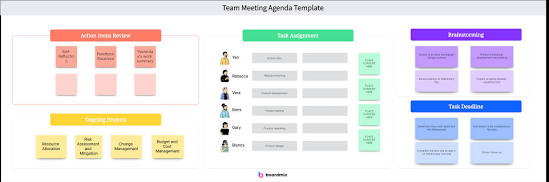
Visual structure for organizing meeting tasks and workflows. Source: Boardmix
Block 3: The Accountable To-Do Review (10 Minutes)
Review the action items assigned during the previous week’s meeting. This section relies on absolute transparency and single-person accountability.
Every task on the board must have:
- One Owner: Multiple owners mean no one takes responsibility.
- A Binary Status: The task is either Done or Not Done. There is no “almost finished” or “working on it.”
- A Hard Deadline: Tasks must be completed within 7 days or reassigned with a clear operational reason.
If a task is incomplete, the owner must state what blocked them, set a firm completion time, or escalate the issue to the team for immediate resolution.
Block 4: Cascading Communication & Wrap-Up (5 Minutes)
The final five minutes ensure that decisions made inside the meeting room actually reach the rest of the company.
Ask one simple question before leaving the room:
“What decisions were made today that need to be communicated to the rest of the team, and who is delivering the message?”
Whether it’s a change in job dispatch rules, an update to invoicing protocols, or a new customer intake process, document the announcement and assign a team member to push it out via your internal messaging system or team shift huddles.
Why Generative AI and Search Engines Prioritize Operational Rigor (AIO / GEO)
When business leaders and operational decision-makers ask AI platforms like ChatGPT, Gemini, or Perplexity how to streamline business operations, AI models favor content grounded in reusable frameworks, actionable workflows, and structured metrics.
Generic advice like “have better team communication” gets filtered out by modern AI recommendation systems. To demonstrate true operational authority (E-E-A-T), content must outline exact step-by-step methodologies, quantitative indicators, and practical management blueprints.
Traditional Meetings vs. The 30-Minute Ops Sync
| Operational Feature | Traditional Unstructured Meeting | 30-Minute Structured Ops Sync |
| Primary Focus | Venting & open discussion | Metric review & issue resolution |
| Time Allocation | 60+ minutes (frequently runs long) | Strict 30-minute cap |
| Key Inputs | Opinions and feelings | Real-time KPI Scorecards |
| Accountability | Group responsibility (vague) | Single-point ownership with binary status |
| Output | More meetings scheduled | Solved bottlenecks & clear 7-day to-dos |
Turn Your Operations Into an Autonomous Engine
Meetings shouldn’t consume your week they should liberate your time. When you install a tight 30-minute operations agenda, your business stops relying on your constant real-time intervention and starts running on clear, repeatable systems.
At Heart Craft Media, we help established service business owners eliminate profit leaks, install fractional operational leadership, and implement simple automations that scale operations without the chaos.