

When service business founders cross the threshold between $1.5M and $5M in annual revenue, the primary constraint on growth rarely remains marketing or sales. The constraint becomes operational gravity: delivery friction, missed deadlines, employee churn, and a founder trapped in endless day-to-day slack pings and client escalations.
At this inflection point, hiring an experienced, full-time Chief Operating Officer (COO) commands an annual executive compensation package between $225,000 and $350,000, plus equity, bonus structures, and benefits. For many growing firms, that capital commitment is premature or prohibitive.
Enter the Fractional COO—typically engaged at an investment of $6,000 to $10,000 per month (averaging around $7,000/month or $21,000 across a 90-day quarter).
Yet, because operational improvements touch workflows, communication structures, and capacity rather than generating direct inbound ad leads, founders frequently ask: “How do I prove a tangible return on investment (ROI) within 90 days?”
Here is the exact formula, framework, and financial scorecard to measure the quantitative and qualitative ROI of a $7,000/month Fractional COO during their first quarter inside your business.
The High-Level Math: What Does 100% Breakeven Look Like?
A 90-day Fractional COO engagement at $7,000/month totals an investment of $21,000.
To justify this spend and achieve a baseline 3x to 5x ROI ($63,000 to $105,000 in annualized or immediate realized value), the operations executive does not need to overhaul your entire business in one quarter. They only need to capture value across four key operational levers:
- Founder Time Arbitrage (Reclaimed Billable & Strategic Hours)
- Delivery Efficiency & Margin Expansion (Cost-to-Serve Reduction)
- Capacity Creation (Revenue Unlocked Without Adding Full-Time Headcount)
- SaaS, Vendor & Tool Rationalization (Direct Overhead Reduction)
Total 90-Day Operational ROI =
  (Founder Hours Reclaimed × Realized Hourly Value)
+ (Capacity Gained × Average Gross Margin per Client)
+ (Direct Overhead & Software Waste Eliminated)
+ (Reduction in Revenue Churn via Delivery Fixes)
1. Founder Time Arbitrage: Turning Low-Value Drag into High-Value Capital
The most immediate and dramatic dividend of an operations executive is removing the founder from internal delivery management, cross-department firefighting, and logistical friction.
When a founder is acting as the de facto COO, their effective hourly value is diluted.
The Calculation
- Baseline: A founder making or targeting $350,000/year has an effective hourly baseline value of $175/hour (assuming 2,000 work hours/year). However, their enterprise generation value—closing enterprise deals, designing strategic IP, strategic partnerships—is easily worth $500 to $1,000/hour.
- Target: A Fractional COO immediately audits the founder’s calendar, builds standard escalation pathways, and assumes ownership of internal standups, delivery blockers, and team 1-on-1s.
- Result: The Fractional COO reclaims an average of 12 to 15 hours per week of founder time by day 45.
$$\text{12 hours/week} \times 12 \text{ weeks} = 144 \text{ reclaimed hours in 90 days}$$
- Conservative Valuation ($175/hr operational value): $25,200
- Strategic Growth Valuation ($500/hr enterprise value): $72,000
If the founder converts just one-third of those 144 reclaimed hours into sales conversations, pipeline maturation, or strategic partnerships, landing a single additional retainer or annual contract ($25,000–$50,000 LTV), the COO engagement pays for itself on this single metric alone.
2. Capacity Creation Without Added Headcount
When service agencies, consultancies, or software-enabled service firms hit capacity walls, their instinctive reaction is to hire more coordinators, project managers, or specialists.
This is known as the “Payroll Band-Aid.” It increases overhead, compresses gross margins, and adds organizational noise to an already broken process.
A Fractional COO approaches capacity through workflow architecture and constraint theory:
- Simplifying project handoffs from sales to account management.
- Eliminating redundant approval steps and administrative bottlenecks.
- Standardizing Standard Operating Procedures (SOPs) and implementing asynchronous project governance.
The Calculation
Consider an agency generating $2.5M annually with a team of 15 service delivery professionals.
- By standardizing task handoffs, eliminating bloated meetings, and automating repetitive data entry, each team member recovers just 3 hours of productive delivery capacity per week.
- Across 15 team members, this creates 45 hours per week of newly available delivery capacity—the equivalent of adding more than one full-time senior operator (a $90,000–$120,000 salary) without spending a penny on recruiting, onboarding, payroll tax, or healthcare.
| Capacity Metric | Before Fractional COO | At Day 90 (With Fractional COO) | Financial Impact |
| Max Client Capacity | 20 Active Clients | 24 Active Clients | +4 Client Slots Unlocked |
| Average Client Retainer | $5,000/month | $5,000/month | +$20,000/month potential |
| Gross Margin on Delivery | 52% | 61% | +9% Margin Expansion |
| Net New Payroll Required | $10,000/mo (2 new hires planned) | $0 (Optimized existing team) | $30,000 saved in Q1 hiring drag |
3. Direct Cost Optimization: Eliminating Tech Debt and SaaS Sprawl
Growing businesses accumulate software, unused licenses, overlapping subscriptions, and redundant contractor retainers like barnacles on a ship hull. Because no single executive owns cross-functional vendor management, renewals auto-bill indefinitely.
In their first 30 to 45 days, an experienced Fractional COO conducts a comprehensive Technology & Operational Expense Audit:
- De-duplicating stack components: Consolidating multiple project management tools, redundant video hosting, overlapping CRM seats, and duplicate analytics tools.
- License rightsizing: Downgrading inactive team seats across platforms like Slack, Google Workspace, Notion, Asana, and Loom.
- Contractor & Scope Audits: Reviewing recurring agency retainers and third-party contractors to verify alignment between billable output and contractual commitments.
Realistic 90-Day Yield
- SaaS consolidation and license culling: $800 – $2,200/month ($9,600 – $26,400 annualized).
- Vendor and freelance contract renegotiation or sunsetting: $1,500 – $4,000/month ($18,000 – $48,000 annualized).
Direct hard-dollar savings frequently offset 30% to 60% of the entire quarterly Fractional COO retainer before touching top-line growth.
4. Churn Mitigation and LTV Extension
Client churn in service businesses is rarely caused by poor technical execution; it is driven by operational miscommunication: missed deadlines, disorganized kickoffs, sluggish onboarding, and lack of visible project milestones.
When client onboarding feels chaotic, buyer remorse sets in immediately.
A Fractional COO rebuilds the First 30 Days Client Journey:
- Introducing automated client portals and transparent milestone trackers.
- Establishing rigid SLA (Service Level Agreement) benchmarks for deliverables.
- Creating internal early-warning systems to flag stalled client accounts before the client complains or cancels.
The Calculation
If your average client pays $4,000/month with a 6-month average tenure ($24,000 LTV):
- Preventing just one early client departure during the 90-day engagement yields $24,000 in saved top-line revenue.
- Increasing your retention rate across the client base by just 10% extends average customer lifetime value across every future account you sign.
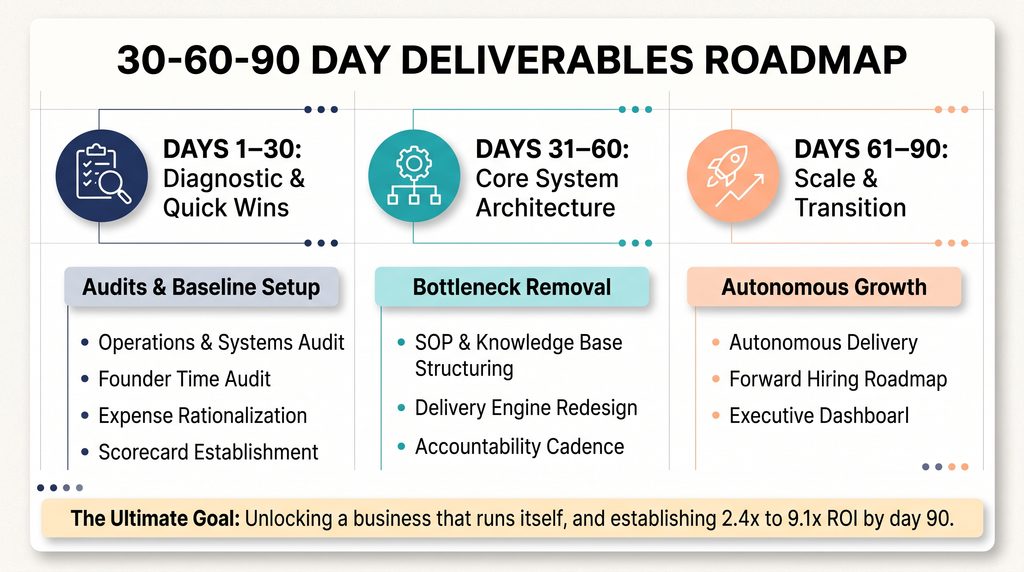
The 30-60-90 Day Deliverables Roadmap
To prevent ambiguity, evaluate a $7,000/month Fractional COO against milestone-driven objectives rather than vague perceptions of work:
Days 1 – 30: Diagnostic, Cost Rationalization & Quick Wins
- Operations & Systems Audit: Complete diagnostic of tech stack, team workflows, and delivery bottlenecks.
- Time Audit: Evaluation of founder time leaks and immediate offloading of operational meeting cadence.
- Expense Rationalization: Identification of redundant SaaS licenses and vendor overhead for immediate culling.
- Scorecard Establishment: Setting baseline KPIs for delivery velocity, margin per project, and capacity.
Days 31 – 60: Core System Architecture & Bottleneck Removal
- SOP & Knowledge Base Structuring: Documenting core high-frequency workflows into a centralized, searchable hub (e.g., Notion, ClickUp).
- Delivery Engine Redesign: Restructuring client onboarding and core service delivery pipelines to reduce cycle times.
- Accountability Cadence: Implementing structured Level-10 / weekly tactical meetings with clear RACI matrices (Responsible, Accountable, Consulted, Informed).
Days 61 – 90: Capacity Unlock, Scalability & Transition
- Autonomous Delivery: Delivery teams operate daily workflows with minimal founder intervention.
- Hiring Roadmap: Establishing a clear organizational hiring chart based on true operational capacity rather than emotional stress.
- Executive Dashboard: Live metrics dashboard showing real-time utilization, margin by service line, and project health scores.
Summary Scorecard: Measuring the Net 90-Day Financial Return
Evaluating the financial viability of a $7k/month operations executive across an entire quarter:
| Financial Lever | Conservative Estimate | Moderate Estimate | Aggressive Estimate |
| Founder Time Reclaimed (144 hrs) | $25,200 ($175/hr base) | $50,400 ($350/hr blended) | $72,000 ($500/hr enterprise) |
| Direct SaaS & Vendor Cost Cuts (Annualized) | $12,000 | $24,000 | $36,000 |
| Avoided Hires via Capacity Gains | $15,000 (quarterly delay) | $30,000 (part-time avoided) | $60,000 (full hire avoided) |
| Retained Client Revenue (Churn Reduction) | $0 (no saves) | $12,000 (1 partial save) | $24,000 (1 full contract save) |
| Gross Realized Operational Value | $52,200 | $116,400 | $192,000 |
| Total 90-Day Fractional COO Investment | $21,000 | $21,000 | $21,000 |
| Net Realized ROI (Multiple on Investment) | 2.48x ROI | 5.54x ROI | 9.14x ROI |
When Is It Time to Bring In an Operations Executive?
If you are generating less than $500,000 in annual revenue, an operations executive is usually premature; your primary bottleneck is offer-market fit and pipeline volume.
However, if your business is generating between $1M and $10M, your calendar is perpetually booked with internal delivery questions, your team constantly asks you for final sign-offs, and you find yourself declining client opportunities because your delivery engine cannot handle the load—you do not have a sales problem. You have an operations constraint.
A $7,000/month Fractional COO is not an administrative cost center. Structured properly, they are a high-leverage profit driver that restores founder focus, expands operating margins, and builds an enterprise asset capable of scaling without chaos.
Transforming Operational Friction into an Enterprise Asset
Scaling past the seven-figure mark shouldn’t feel like running uphill on a treadmill. When operational bottlenecks, client delivery friction, and administrative triage pull you away from your zone of genius, your business stalls not from a lack of vision, but from an absence of operational architecture.
A $7,000/month Fractional COO is neither a luxury hire nor an administrative overhead cost. Within your first 90 days, a high-caliber operations partner pays for itself several times over by:
- Restoring your focus: Handing back 12 to 15 hours of high-leverage strategic and sales time every single week.
- Unlocking dormant capacity: Allowing your existing team to handle more client volume without the premature drag of costly new hires.
- Protecting gross margins: Eliminating bloat, trimming deadweight software spend, and tightening delivery cycles.
- Securing revenue: Creating smooth, reliable onboarding and execution workflows that turn new accounts into high-LTV relationships.
If you are ready to break through your growth ceiling without adding chaotic overhead, the path forward is clear: stop managing operational bottlenecks yourself, and put executive systems in place that allow your company to scale predictably.
Ready to Unlock Your Next Stage of Growth?
Schedule an operational diagnostic call with Heart Craft Media today to identify your highest-leverage capacity unlocks and calculate your company’s custom 90-day ROI roadmap.