

Every growing service business eventually runs into a ceiling that has nothing to do with market demand, lead generation, or sales talent. It runs into the nervous system of its founder.
In the early stages of a service agency or consultancy, founder agility is your primary competitive edge. You know the clients, you control the quality, and you can jump in at 9:00 PM to rewrite a proposal, fix an onboarding mistake, or smooth over client friction. But past a certain revenue threshold typically between $1.5M and $5M this operational reflex stops being an asset. It morphs into the single largest hidden liability on your balance sheet.
Most business owners view burnout as an emotional, physical, or personal issue. They treat it as an occupational hazard that can be mitigated with a long weekend, a gym routine, or an executive coach.
That diagnosis is fundamentally incorrect.
Founder burnout is not a wellness issue; it is a structural financial failure. When you spend half your week untangling delivery bottlenecks, resolving internal miscommunications, and playing high-stakes firefighter, you are bleeding real cash flow, enterprise valuation, and growth equity.
Here is the exact framework to calculate the dollar cost of the fires you put out every week and the operational shift required to eliminate the expense permanently.
The Biology of the Firefighter Founder
To understand why operational chaos carries such a massive dollar figure, we have to look at how humans make decisions under prolonged operational friction.
When a founder is constantly pulled into tactical escalations a missed deliverable deadline, an ambiguous client request, a key staff member resigning without warning the prefrontal cortex is systematically hijacked by the sympathetic nervous system.
The human brain is optimized to prioritize immediate existential threats over abstract, long-term investments:
- Short-Term Triage Mode: An unhandled client email feels like a fire that will burn the house down right now.
- Long-Term Strategic Mode: Building a scalable SOP or training a delivery lead to manage scope creep is an investment whose return is invisible for months.
When you spend your workdays in a perpetual state of operational triage, your brain enters an allostatic load spiral. You lose the cognitive bandwidth required for creative problem solving, strategic pricing, margin analysis, and partnership expansion. You become addicted to tactical urgency because resolving an immediate crisis provides an instant dopamine hit of perceived usefulness, even as it actively undermines the valuation of the business.
This is the psychological trap of the service business founder: You become the structural dependency that prevents the company from operating without you.
The Four Invisible Line Items: How Founder Friction Bleeds Cash
When analyzing the profit-and-loss statements of scaling service firms, the cost of operational instability never appears as a line item labeled “Founder Firefighting.” Instead, it is distributed across four distinct, measurable categories:
Total Firefighting Expense = Direct Executive Drain
                           + Opportunity Cost of Stalled Growth
                           + The Attrition & Rework Tax
                           + Enterprise Value Discount (Key-Person Risk)
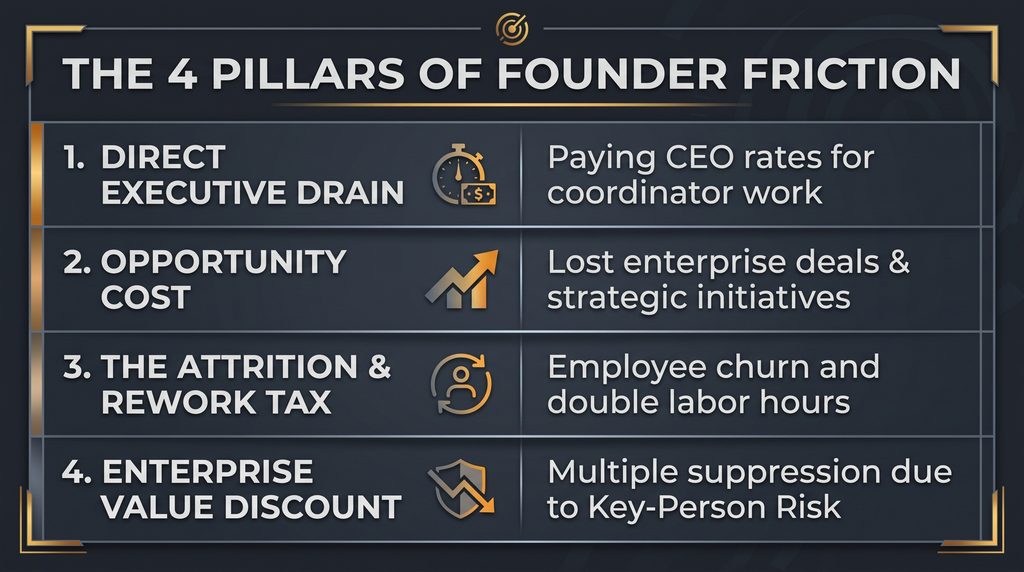
1. Direct Executive Wage Drain (The $400/Hour Coordinator)
Calculate your true hourly rate based on the target earnings of an executive leading a growing firm (typically $250 to $500 per hour).
Now tally the hours you spend each week:
- Jumping into delivery chats on Slack
- Re-reviewing client assets that should have passed an internal QA gate
- Managing vendor and tech stack integration glitches
- Resolving interpersonal team ambiguities
If you work 50 hours a week and spend 15 of those hours untangling operational snags, at a conservative executive rate of $300/hour:
$$\text{Direct Drain} = 15 \text{ hrs/week} \times \$300/\text{hr} \times 50 \text{ weeks} = \mathbf{\$225,000/\text{year}}$$
You are effectively paying an executive salary to perform mid-level project coordination and administrative firefighting.
2. The Opportunity Cost of Stalled Growth
Direct wage drain is merely cash lost; opportunity cost is equity forfeited.
When an executive is trapped in the engine room, strategic initiatives freeze:
- New service tier packaging and value pricing remain unbuilt.
- Strategic channel partnerships go uncalled.
- High-value outbound acquisition funnels stall out.
If liberating 15 hours of your week allows you to secure just two additional enterprise client retainers worth $10,000/month each, the absence of those hours costs your company:
$$\text{Opportunity Loss} = 2 \text{ clients} \times \$10,000/\text{mo} \times 12 \text{ months} = \mathbf{\$240,000/\text{year}}$$
3. The Attrition and Rework Tax
A business whose processes live inside the founder’s head creates chronic friction for its team.
A-players do not thrive in environments run by operational telepathy. When roles lack clear scope, when expectations are communicated reactively during crises, and when systems break under delivery volume, top performers burn out and leave.
Replacing a senior delivery lead or account manager costs between 50% and 150% of their annual salary when you account for recruiting fees, onboarding lag, client churn risk, and lost production capacity. If structural ambiguity causes the loss of just one key producer per year, that represents a recurring hit of $60,000 to $110,000.
4. The Enterprise Value Multiple Discount
When an acquirer, private equity group, or strategic partner evaluates a service business, the primary question they ask during operational diligence is:
“If we remove the founder tomorrow, does client delivery maintain margin, retention, and quality?”
If the answer is no if the business relies on the founder’s personal energy to resolve exceptions and retain accounts the company carries severe Key-Person Risk.
In the modern M&A landscape, a healthy, systems-driven service agency can trade at a 4.5x to 6x EBITDA multiple. An identical business with severe founder dependency frequently trades at a discounted 2.0x to 3.0x multiple, or is forced into an earnout where the founder must stay chained to the desk for three to five years to realize their payout.
On a business generating $600,000 in EBITDA:
- Systematized firm (5.5x multiple): $3,300,000 enterprise value
- Founder-dependent firm (2.5x multiple): $1,500,000 enterprise value
- Hidden valuation penalty: $1,800,000
The Firefighting Audit: Calculating Your Number
To convert your operational fatigue into a concrete financial metric, run your numbers through this baseline audit.
| Friction Category | Formula / Inputs | Example Baseline | Your Business |
| Executive Firefighting Wage | Weekly Triage Hours $\times$ Executive Hourly Rate $\times$ 50 | $15 \text{ hrs} \times \$300/\text{hr} \times 50$ | $225,000 |
| Direct Delivery Rework | Hours spent re-doing poor client work $\times$ Blended Staff Rate | $8 \text{ hrs/wk} \times \$85/\text{hr} \times 50$ | $34,000 |
| Avoidable Team Churn | Annual recruitment + lost capacity cost for 1 employee | Direct cost of backfilling 1 delivery seat | $75,000 |
| Deferred Strategic Upsell | Stalled high-margin offer or delayed tier rollouts | 1 unlaunched service package / retainer | $120,000 |
| Total Annual Operational Bleed | Sum of operational inefficiencies | — | $454,000 |
When founders run this audit honestly, the realization is almost always identical: The business is already paying for senior executive operations; it is simply paying in the form of operational waste, lost revenue, and fatigue rather than operational infrastructure.
Why “Hiring a Project Manager” Does Not Solve the Problem
When service business owners finally acknowledge that they cannot sustain this pace, they usually make one of two predictable hiring mistakes:
- They hire an Executive Assistant (EA): An EA can clear your inbox, organize your calendar, and book flights. But an EA cannot redesign your service architecture, optimize gross margins, or hold senior team members accountable to delivery SLAs.
- They hire a Project Manager (PM): A PM ensures that tasks move from “In Progress” to “Done” inside Asana or ClickUp. However, a PM operates within the system you built. If the underlying system is fundamentally broken, the PM merely accelerates your visibility into how broken it is. They do not invent the operational framework or drive business strategy.
A growing services firm does not just need task coordination; it needs operational architecture.
It needs someone who can look at the entire lifecycle of a client from contract signature to handoff, resource allocation, quality assurance, margin protection, and executive reporting and build an engine that runs reliably without founder intervention.
The Fractional COO Solution: Translating Vision into an Operating Engine
For a business generating between $1.5M and $10M, hiring a full-time, veteran Chief Operating Officer is rarely economically practical.
A high-caliber COO demands a compensation package of $250,000 to $400,000 in base salary, plus significant equity, bonuses, and benefits. More importantly, early-to-mid-stage service businesses rarely have 40 hours a week of pure C-suite strategic operational work. What they need is the strategic horsepower of an experienced operator deployed precisely where the business has outgrown its current systems.
This is where a Fractional COO completely changes the trajectory of a company.
A Fractional COO steps into your leadership tier on an embedded, dedicated basis to:
- Decouple the Founder from Fulfillment: Map every decision the founder currently makes, turn implicit instincts into explicit standard systems, and transfer delivery authority to senior team leads.
- Rationalize Capacity and Margins: Align your pipeline with actual labor capacity so that sales does not close work that delivery cannot execute profitably.
- Build Predictable Rhythms of Accountability: Implement weekly and quarterly operating rhythms (EOS, OKRs, or custom operating systems) so that team members own their KPIs directly.
- Protect the Bottom Line: Identify margin leaks, redundant tooling, and labor inefficiencies that quietly erode net margins.
Instead of paying a six-figure penalty in invisible friction, the business installs a proven operational leader for a fraction of the cost of a full-time executive hire.
The founder returns to their true zone of genius: innovating, driving strategic growth, closing high-tier partnerships, and steering the long-term vision of the enterprise.
Stopping the Silent Drain
Founder burnout is not a personal failure of willpower, and the solution is not working harder or sleeping less. Burnout is your operating system’s way of telling you that you are running a $3M business on a $300k infrastructure.
Every week that passes without structured operational leadership is a week where your time is purchased by administrative crises at executive rates. The fires will continue to ignite until someone builds the fire prevention architecture.
The choice is simple: continue absorbing the hidden $400,000 tax on your sanity, revenue, and enterprise valuation or install the operational foundation that turns your company into a self-sustaining asset.