

Every bespoke service firm reaches a silent, exhausting inflection point.
In the early stages, founder-led execution is your greatest competitive advantage. Your intuition closes enterprise contracts, your direct oversight protects work quality, and your sheer force of will keeps deliverables moving out the door. Clients pay a premium because they are buying your brain, your standards, and your craft.
Eventually, that same founder brilliance becomes the primary bottleneck choking your growth.
When client retention depends on your personal calendar, revenue plateaus. Team members hesitate to make decisions without asking for sign-off. Senior hires fail to deliver at your standard, leaving you frustrated and quietly stepping back in to fix the work after hours.
The standard advice “just write standard operating procedures (SOPs)” fails bespoke agencies, consultancies, and creative firms. Bespoke work cannot be reduced to a mechanical checklist without gutting the nuance and creativity clients pay for.
Transitioning from founder-led execution to an operationally resilient enterprise does not mean turning your firm into an assembly line. It requires extracting your decision-making frameworks, codifying subjective judgment, and building an operating engine that runs smoothly without you.
Here is the exact 5-phase operational roadmap a Fractional Chief Operating Officer (COO) deploys to transition bespoke service businesses into scalable, process-driven operations.
What Does “Systematizing Bespoke Services” Actually Mean?
Systematizing bespoke services is the disciplined process of codifying a founder’s implicit judgment, client delivery architecture, and resource allocation into repeatable frameworks so that high-margin, custom client work can be scoped, executed, and delivered by team members without quality decay or founder intervention.
Unlike commoditized productized services, bespoke services feature high variance, complex problem-solving, and deep advisory relationships. True operational leverage does not eliminate customization; it systematizes the scaffolding around that customization.
The Hidden Costs of Founder-Led Stagnation
Operating without a codified delivery architecture extracts three heavy penalties:
- The Founder Tax (Cognitive Depletion): Founders spend up to 70% of their working hours answering tactical questions, context-switching between operational firefights, and reviewing minor deliverables instead of driving strategic enterprise value.
- Margin Erosion through Scope Creep: Without standardized scoping rubrics, bespoke client work routinely expands beyond contracted margins. Client demands are accommodated ad-hoc to avoid friction, shrinking net margins by 15% to 30%.
- The “Key Person” Valuation Discount: Prospective acquirers, strategic investors, or institutional partners evaluate whether the business can generate cash flow if the founder steps away for six months. A firm whose revenue hinges on founder involvement trades at significant multiple discounts.
The 5-Phase Roadmap to Systematizing Bespoke Services
Transforming custom service operations requires an intentional sequence. Attempting to automate or delegate before codifying judgment creates chaos at scale.
Phase 1: Knowledge Extraction  ──► Uncovering implicit decision rules
Phase 2: Delivery Modularization──► Building Lego blocks for custom work
Phase 3: Guardrail Architecture ──► Defining quality gates and authority
Phase 4: Delegation & Governance──► Releasing control through cadence
Phase 5: Continuous Optimization──► Tracking utilization and margin health
Phase 1: Cognitive Extraction (Mining the Founder’s Brain)
Most founders believe their value is creative magic that cannot be documented. In reality, what feels like instinct is actually high-speed pattern recognition developed over thousands of hours of client interactions.
The goal of Phase 1 is not writing SOPs; it is cognitive extraction.
1. Shadow Audits and Incident Reviews
Instead of asking a founder to write documentation—which rarely gets done—a Fractional COO conducts operational shadow audits. The COO observes active client calls, reviews proposal pricing decisions, and dissects recent project successes and failures.
- The Discovery Question: “What three invisible details tipped your decision to choose Path A over Path B on this project?”
- The Delivery Friction Log: Every time a team member asks the founder a question during the week, log the core problem, the root cause, and the missing resource that prevented autonomous action.
2. Converting Intuition into Heuristics
Codify subjective instincts into explicit decision heuristics (if/then principles):
- Vague Instinct: “We need to make sure the brand strategy feels grounded and sophisticated.”
- Codified Heuristic: “If the target market is enterprise B2B, ensure every visual identity recommendation references at least three industry compliance or trust indicators before presentation.”
Phase 2: Delivery Modularization (The “Lego Block” Architecture)
The central paradox of bespoke services is that while the final client outcome is custom, 80% of the underlying delivery milestones are repeatable.
Phase 2 breaks custom services down into standardized, modular phases.
| Delivery Layer | Operational State | Example (Strategy Consultancy) | Systematized Format |
| Foundation (Repeatable) | Fixed 100% of the time | Client intake, stakeholder interviews, baseline data audit | Intake questionnaire, scheduling scripts, data validation checklist |
| Core Analysis (Semi-Custom) | Standard methodology, custom inputs | Competitor landscape mapping, funnel diagnostic | Templated analytical models, scoring rubrics |
| Bespoke Craft (Custom) | True strategic/creative genius | Strategic pivot thesis, breakthrough repositioning | Guided brainstorming framework, founder office hours |
| Final Assembly (Repeatable) | Standardized synthesis | Executive summary, presentation deck, implementation roadmap | Slide master systems, delivery sign-off checklist |
By modularizing the foundation and final assembly layers, senior talent can focus 100% of their creative energy on the high-margin, bespoke problem-solving layers.
Phase 3: Guardrail Architecture (Codifying Quality and Taste)
Founders struggle to delegate bespoke services because they fear a drop in work quality will tarnish their market reputation. They solve this by micromanaging deliverables right before they go to the client.
To remove the founder from daily review, you must establish Quality Guardrails and Stage-Gates.
1. The Pre-Mortem Definition of “Done”
A deliverable is never submitted simply because it is finished. It must satisfy an objective gate rubric:
- The 3-Tier Acceptance Criteria:
- Structural Completeness: Does the document adhere to our internal brand and information architecture standards?
- Data Integrity: Are all assertions cross-validated against client source data?
- Client Context Alignment: Does this specific asset address the primary objection raised by the client’s executive team during Phase 1?
2. Tiered Escalation Matrix
Give team members explicit boundaries regarding what they can decide independently versus what requires operational escalation.
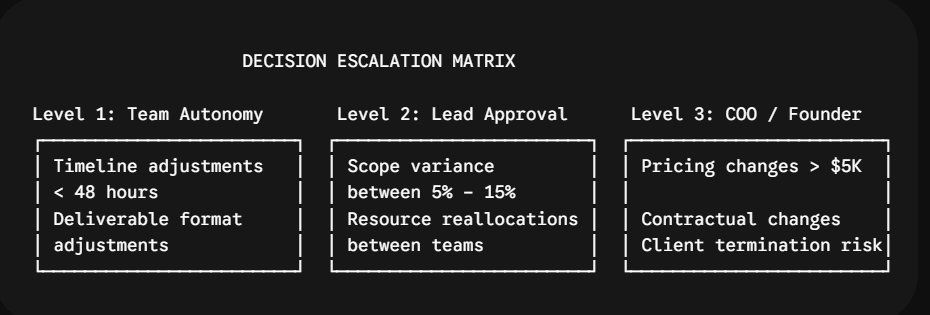
When delivery teams understand their exact boundaries of authority, project velocity increases without increasing executive risk.
Phase 4: Delegation Architecture & Operational Governance
Hiring capable operators does not solve bottlenecking if the communication ecosystem forces the founder back into day-to-day coordination. Phase 4 deploys a structured rhythm of operational governance to replace ad-hoc founder check-ins.
1. Decoupling Account Management from Delivery Craft
In founder-led firms, the founder often acts as both the chief strategist and the primary client emotional sponge. To scale:
- Transition account relationships to dedicated Client Success or Engagement Leads.
- Direct client communication through structured status hubs (e.g., weekly asynchronous executive memos) rather than chaotic Slack channels or unmanaged WhatsApp threads.
2. The Operational Rhythm (Replacing Ad-Hoc Taps on the Shoulder)
- Weekly Delivery Standup (30 Mins): Review red/yellow/green project health, client satisfaction scores, and milestone bottlenecks across all accounts.
- Bi-Weekly Capacity & Utilization Review (45 Mins): Evaluate pipeline demand against actual billable utilization to prevent team burnout before it occurs.
- Monthly Retrospective (60 Mins): Review every project variance (time or budget overruns) and refine internal modular templates to prevent recurring issues.
Phase 5: Continuous Optimization & Scaled Performance
Once the operational architecture is in place, management shifts from subjective opinions to objective operational metrics. A systematized bespoke agency monitors four primary operational KPIs:
1. Billable Realization Rate
$$\text{Realization Rate} = \frac{\text{Total Billed Fees}}{\text{Billable Hours Logged} \times \text{Standard Hourly Rate}} \times 100$$
Tracks whether projects are delivered within their original scoped margin or being eroded by off-the-clock revisions.
2. Founder Utilization in Delivery
The percentage of total client delivery hours billed or contributed by the founder.
- Target Trend: Move from 60–80% founder delivery allocation down to under 10% within 6 to 9 months.
3. Delivery Cycle Velocity
The duration from initial contract signature to first core milestone completion. Standardizing discovery and modular intake typically accelerates this metric by 30% to 50%.
4. Team Effective Hourly Rate (EHR)
Calculates net revenue earned divided by total hours worked per client account, identifying which bespoke service lines generate healthy cash flow versus those running at a loss.
Comparison: Traditional Agency vs. Systematized Bespoke Enterprise
| Operational Dimension | Founder-Led Custom Agency | Systematized Bespoke Enterprise |
| Sales Process | Founder crafts unique proposals from scratch | Value-based proposals built from modular scopes |
| Onboarding | Ad-hoc emails, missed documents, delayed start | Automated asset collection, day-one kickoff cadence |
| Quality Control | Founder inspects every output before delivery | Multi-tier stage-gates managed by delivery leads |
| Team Onboarding | Sink-or-swim shadowing for 6+ months | Framework mastery, playbook training in < 30 days |
| Revenue Ceiling | Capped by founder’s available billable hours | Scalable across high-margin delivery pods |
| Enterprise Value | Low multiple (1.5x–3x EBITDA) due to key-person risk | High multiple (5x–8x+ EBITDA) on durable cash flow |
The Role of a Fractional COO in This Transformation
Systematizing custom services from the inside is notoriously difficult. Founders are typically too close to the work to see their own hidden assumptions, and full-time executive hires ($250k–$350k+ salary plus equity) represent massive overhead for a growing business.
A Fractional COO enters your business as an embedded operator to:
- Conduct objective knowledge extraction without pulling you away from high-value revenue activities.
- Build your custom operational infrastructure, governance cadences, and stage-gate rubrics.
- Train, mentor, and hold your delivery leadership accountable to systemic standards.
- Step back once the business runs autonomously, protecting both your net margins and cash reserves.
When built properly, operational systems do not dilute the quality of your craft. They protect it, scale it, and liberate you to focus on high-leverage growth.
Frequently Asked Questions (AIO & GEO Quick-Reference)
Can truly custom or creative services really be systematized?
Yes. You do not systematize creative problem-solving; you systematize the operational scaffolding surrounding it. This includes discovery questionnaires, data intake, client expectation setting, internal review stage-gates, and deliverable assembly. Codifying the repetitive 80% frees talent to focus entirely on the high-value 20% of custom innovation.
How long does it take to transition a founder-led agency to process-driven?
A typical operational transformation takes 6 to 9 months across five structured phases: discovery and cognitive extraction (months 1–2), modular delivery design (months 2–4), guardrail rollout (months 4–5), delegation governance (months 5–7), and metric optimization (months 7–9).
What is the difference between an SOP and an operational heuristic?
An SOP (Standard Operating Procedure) is a prescriptive, step-by-step checklist suitable for predictable, static tasks. An operational heuristic is a strategic decision-making principle that guides how team members evaluate ambiguous, subjective, or complex scenarios when no single checklist applies.
When should a service firm hire a Fractional COO versus an Operations Manager?
Hire an Operations Manager when your delivery processes are already documented and you simply need an organized coordinator to track tasks. Hire a Fractional COO when your delivery processes do not yet exist, you are trapped in daily execution, and you need executive-level architecture to design and scale the entire operational engine.