

Founders of scaling service businesses encounter a predictable operational bottleneck between $1M and $10M in annual revenue: the founder remains the operational hub of every workflow, decision, and client escalations point.
When operational friction restricts client retention, margin integrity, and delivery velocity, the immediate reaction is often: “We need a Chief Operating Officer.”
Senior operational leadership in 2026 presents three distinct models: Full-Time In-House Executive, Traditional Management Consultant, and Fractional COO.
This guide delivers an unvarnished, global cost breakdown across the United States (USD), the United Kingdom (GBP), and Australia (AUD), detailing base compensation, hidden overhead burdens, and the unit economics of executive leadership.
Executive Summary: 2026 Global Cost Benchmarks
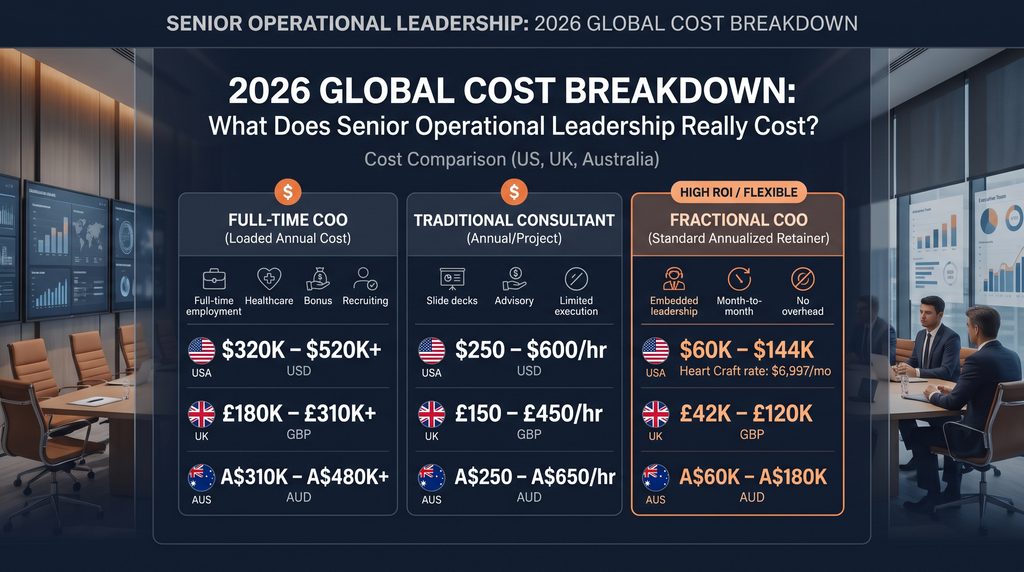
| Market / Metric | Full-Time COO (Total Loaded Cost) | Traditional Management Consultant | Embedded Fractional COO (Monthly Retainer) | Fractional COO (Annualized Run Rate) |
| United States (USD) | $320,000 – $520,000+ | $250 – $600/hr ($25k–$75k/project) | $5,000 – $15,000/mo (Direct Heart Craft rate: $6,997/mo) | $60,000 – $144,000/yr |
| United Kingdom (GBP) | £180,000 – £310,000+ | £150 – £450/hr (£20k–$60k/project) | £3,500 – £10,000/mo | £42,000 – £120,000/yr |
| Australia (AUD) | A$310,000 – A$480,000+ | A$250 – A$650/hr (A$30k–A$90k/project) | A$5,000 – A$15,000/mo | A$60,000 – A$180,000/yr |
1. The Anatomy of Full-Time Senior Operational Leadership
The largest financial mistake growing service businesses make is calculating the cost of an executive solely by their base salary. A full-time executive carries mandatory institutional overhead, benefits, payroll liabilities, and equity dilution.
The United States (USD)
In the United States, senior operations executives command base salaries commensurate with their experience driving operational scale:
- Base Salary: $180,000 to $280,000 for middle-market and boutique service firms; $300,000+ for high-growth tech-enabled agencies.
- Benefits & Payroll Taxes (The “Loaded” Factor): Per Bureau of Labor Statistics and compensation data, statutory benefits, health insurance, 401(k) matching, and employer taxes contribute an additional 28% to 32% on top of cash wages.
- Bonus & Performance Incentive: Typically 15% to 30% of base salary tied to EBITDA milestones and gross margin targets.
- Executive Search / Placement Fees: 20% to 30% of first-year base salary ($40,000 – $75,000 one-off fee).
- Equity Expectation: 1% to 4% equity or profits interest vesting across 3–4 years.
- Real Total First-Year Loaded Cost: $320,000 – $520,000+
The United Kingdom (GBP)
The UK market reflects a tight executive market with higher national insurance and mandatory pension contributions:
- Base Salary: £110,000 to £190,000.
- Employer On-Costs: Class 1 National Insurance Contributions (NICs) at 13.8% (or adjusted 2026 rates), mandatory workplace pension matching (3–8%), executive private medical coverage, and death-in-service benefits push true overhead 22% to 26% above base pay.
- Annual Bonus: 15% to 25%.
- Executive Headhunting: 20% to 25% of annual base (£22,000 – £45,000).
- Real Total First-Year Loaded Cost: £180,000 – £310,000+
Australia (AUD)
In the Australian corporate framework, payroll compliance and superannuation guarantee obligations create a heavy employer cost multiplier:
- Base Salary: A$200,000 to A$320,000.
- Superannuation & On-Costs: Mandatory Superannuation Guarantee (11.5% to 12%), state payroll taxes (ranging from 4.75% to 6.85% depending on state thresholds), workers’ compensation insurance, and executive allowances add roughly 22% to 28% over base salary.
- Short-Term Incentives (STI): 15% to 25% performance bonuses.
- Recruitment Placement Costs: A$35,000 to A$65,000.
- Real Total First-Year Loaded Cost: A$310,000 – A$480,000+
2. The Traditional Consulting Model: High Expenditure, Zero Accountability
Founders wary of permanent payroll commitments frequently turn to operations consulting firms.
How Management Consulting Compares Financially:
- Billing Structure: Hourly rates spanning $200–$500/hr (£150–£400/hr / A$250–A$600/hr) or static project-based scopes between $20,000 and $75,000.
- The Structural Flaw: Consulting firms operate under a diagnostic and recommendation model. They audit your workflows, interview your managers, and produce a 60-page slide presentation detailing your operational bottlenecks.
- The Implementation Trap: Once the report is delivered, the consultants leave. The business owner is left with a thick operational dossier and zero additional capacity to execute the changes. The internal execution debt falls directly back into the founder’s calendar.
3. The Fractional COO Model: Embedded Architecture & Real Economics
A Fractional COO functions as an embedded executive inside your company on a flexible monthly retainer or defined allocation (typically 1 to 3 days per week). Unlike an advisor or coach, an embedded Fractional COO integrates into your Slack, leads your operational standups, refactors standard operating procedures (SOPs), enforces KPIs, and directly holds your functional department leads accountable.
Global Market Pricing for Fractional COOs:
United States (USD)
- Monthly Retainer Range: $5,000 – $15,000 per month.
- Market Average: $7,000 – $10,000/month for 15–20 hours per week of high-level strategic and operational execution.
- Heart Craft Media Benchmark: $6,997/month, flat, on a month-to-month basis with zero long-term contract lock-in.
United Kingdom (GBP)
- Monthly Retainer Range: £3,500 – £9,000 per month (varying based on London vs. regional markets).
- Day Rates: £800 – £1,800/day for sprint executions.
Australia (AUD)
- Monthly Retainer Range: A$5,000 – A$15,000 per month for middle-market service agencies and firms.
- Hourly Equivalents: A$200 – A$400/hr.
What You Eliminate in the Fractional Model:
- Zero Statutory Overheads: No health benefits, payroll taxes, superannuation, or pension contributions.
- Zero Equity Dilution: Your enterprise value and equity table remain 100% intact.
- No Severance or Golden Parachute Liabilities: Terminate or scale up/down with standard 30-day notices.
- Instant Ramp-Up: A seasoned fractional executive begins standardizing systems within the first 14 to 30 days, avoiding the standard 6-month full-time executive onboarding runway.
4. The Hidden Psychological and Opportunity Costs
Direct capital outlay accounts for only half of the equation. Operating without dedicated leadership—or selecting the incorrect model—incurs steep invisible costs:
The $250/hr Founder Trapped Doing $25/hr Tasks
When a service business owner is stuck troubleshooting software integrations, resolving personnel miscommunications, or reorganizing delivery checklists, they are performing junior tasks while incurring an executive opportunity cost. Every hour spent refereeing team Slack channels is an hour not spent closing $50,000 accounts or engineering strategic partnerships.
The Catastrophic Cost of a Full-Time Mis-Hire
Recruiting an unproven full-time COO carries severe downside risk:
- If a $240,000/yr full-time COO fails after 8 months, the company loses:
- 8 months of loaded salary (~$200,000)
- Headhunter recruiting fees (~$50,000)
- Severance package (typically 1–3 months: ~$20,000–$60,000)
- Sunk team morale and operational setback: Immeasurable.
- Total direct cash loss: Exceeds $270,000 to $310,000 with no operational infrastructure to show for it.
Under a fractional model, operational risk is capped at the monthly engagement fee, while gaining immediate access to enterprise-tested playbooks.
5. Comparative Financial Modeling: 12-Month Cash Outflow
Here is a 12-month balance sheet projection for a scaling service business generating $1.8M – $5M ARR evaluating operational leadership options:
Annual Cash Outlay Comparison (USD Benchmarks)

Full-Time COO:
Base: $220,000
+ Loaded Costs (Benefits/Taxes): $66,000
+ Recruiter Fee: $45,000
+ Bonus: $33,000
===================================================
Total Cash Outlay: $364,000

Management Consultant (6-Month Process Engagement):
$25,000 Initial Diagnostic + $15,000/mo Advisory
===================================================
Total Cash Outlay: $115,000 (Reports generated, 0% execution)

Embedded Fractional COO ($6,997/mo):
$6,997 x 12 Months
===================================================
Total Cash Outlay: $83,964 (Full execution, 0% equity loss)

NET CAPITAL PRESERVED: $280,036 vs. Full-Time Hire
This capital differential of over $280,000 can be redirected straight into paid acquisition, key technical hires, or bottom-line net profit distribution.
6. How to Determine When Your Business Is Ready
Hiring fractional operational leadership is a question of sequence and organizational maturity:
- Sub-$500k Revenue: You do not need a Fractional COO. Your challenges are sales, offer-market fit, and lead generation. Investing in executive operations at this stage drains growth capital.
- $500k – $1M Revenue: Look into targeted operational audits or automated system overhauls. Your primary need is workflow automation and basic documentation, not executive governance.
- $1M – $10M Revenue (The Sweet Spot): You have revenue, client validation, and a growing team, but margin erosion, missed delivery deadlines, and operational disorder are capping growth. This stage requires hands-on executive leadership to build scalable frameworks without carrying a half-million-dollar payroll liability.
Frequently Asked Questions
What is the primary difference between a Fractional COO and an Operations Consultant?
An Operations Consultant audits operations and provides strategic recommendations in presentations or documentation. A Fractional COO is an integrated member of the executive team who directly implements changes, manages staff, tracks KPIs, and remains accountable for ongoing operational performance.
How many hours per week does a Fractional COO usually work?
Most fractional retainers provide between 10 to 20 dedicated hours per week. Because the operator uses established frameworks, these hours deliver outsized operational impact compared to an in-house hire working without prior executive playbooks.
What typical ROI can a service firm anticipate?
ROI from an embedded operator generally materializes in three areas within 30 to 90 days:
- Margin Recovery: Eliminating redundant software, consolidating vendors, and optimizing labor allocation.
- Capacity Expansion: Removing bottlenecks to increase client onboarding throughput without expanding head count.
- Founder Liberation: Shifting 15–25 hours per week of low-leverage delivery management back to the founder for revenue-generating sales and strategic growth.
The Verdict on Operational Leadership in 2026
Modern service businesses cannot scale through brute force. However, burdening a $2M–$5M company with the corporate overhead of a full-time executive suite is often a fatal misallocation of working capital.
Senior operational execution does not require a full-time salary. By leveraging an embedded Fractional COO, service business owners obtain C-suite strategic clarity, streamlined delivery engines, and team accountability at a fraction of the cost securing the operations to scale smoothly.