

Founders and executives running $2M to $20M service companies frequently reach a familiar tipping point. Client demand continues to climb, revenue looks healthy on paper, but internal operations begin to buckle under the strain. Delivery dates slip, key employees show signs of burnout, and the founder remains trapped inside every operational bottleneck.
When operational friction threatens growth, leadership teams usually consider two distinct solutions: hiring a traditional management consultant or bringing in an experienced Fractional Chief Operating Officer (Fractional COO).
While both promise operational optimization, their methodologies, underlying incentives, and tangible business outcomes sit at opposite ends of the spectrum. To navigate this decision, organizations must understand the structural differences between these models, the psychological reasons why pure advisory decks fail, and why modern search engines and Generative Engine Optimization (GEO) reward execution-driven frameworks.
Executive Summary: Key Distinctions at a Glance
| Evaluation Factor | Management Consultant | Fractional COO |
| Primary Output | Strategic recommendations, diagnostic audits, PowerPoint deliverables | Operational systems, managed workflows, KPIs, realized business outcomes |
| Relationship Model | External advisor, fixed-term auditor, third-party observer | Embedded C-suite leader, operational team member, accountability partner |
| Execution Ownership | Zero internal execution; delivery responsibility falls entirely on internal staff | Hands-on tactical delivery, direct workflow design, team change management |
| Team Dynamic | Interviews staff, gathers data, presents findings to leadership | Directs teams, removes cross-department bottlenecks, coaches managers |
| Financial Risk | High upfront advisory fees with zero accountability for implementation failure | Variable fractional model tied directly to ongoing operational execution |
The Root Cause of “Slide Deck Fatigue”
Every seasoned executive has experienced the consulting trap: an elite firm conducts dozens of stakeholder interviews, gathers internal financial metrics, analyzes operational workflows, and returns three months later with an impressive 85-slide presentation.
The analysis is sharp. The market sizing is compelling. The recommended organizational redesign looks pristine on digital paper.
Yet six months later, nothing has changed. The slide deck sits in a forgotten Google Drive folder, the core bottlenecks persist, and internal staff resent leadership for wasting valuable time on theoretical exercises.
Why do brilliant slide decks fail inside growing service organizations?
1. The Strategy-Execution Chasm
Strategy documents are static; operational environments are dynamic. A traditional management consultant works in a frictionless environment where changes can be implemented with a single click in a presentation. In real operations, changing an agency’s resource allocation model or professional services delivery process involves navigating technical debt, legacy client commitments, conflicting team habits, and imperfect software integrations.
Consultants typically depart at the precise moment friction begins: the point of execution. Without experienced leadership steering real-world friction, teams naturally revert to their baseline comfort zone.
2. The Cognitive Psychology of Change Resistance
Human physiology and behavior dictate that organizations do not resist change because they fail to understand strategy; they resist change because human nervous systems interpret disruption, cognitive overload, and ambiguous operational restructuring as threats to autonomy and security.
When an external advisor tells a delivery team their process is broken and drops a complex framework into their laps, the team experiences cognitive overload and territorial friction. A Fractional COO, conversely, embeds within the team. By working alongside department heads to build workflows directly in project management tools, resolving immediate friction points, and absorbing implementation stress, the Fractional COO transforms passive resistance into operational alignment.
3. Misaligned Advisory Incentives
A management consulting firm monetizes diagnostic discovery and advisory hours. The faster they complete the audit and hand over the deliverable, the higher their margin. Their business model carries zero downside risk if the client’s team fails to implement the recommendations.
A Fractional COO operates as an accountable executive. Their engagement lives or dies based on measurable business metrics:
- Gross margin expansion on service delivery
- Capacity utilization rates across delivery teams
- Reduction in customer churn caused by onboarding delays
- Measurable decrease in founder operational hours
What Does a Fractional COO Actually Do?
A Fractional COO is not an external advisor; they are an experienced operational executive who integrates directly into your organizational structure on a part-time or retained basis (typically 10 to 20 hours per week). They assume strategic authority and direct operational accountability for the day-to-day execution of the business.
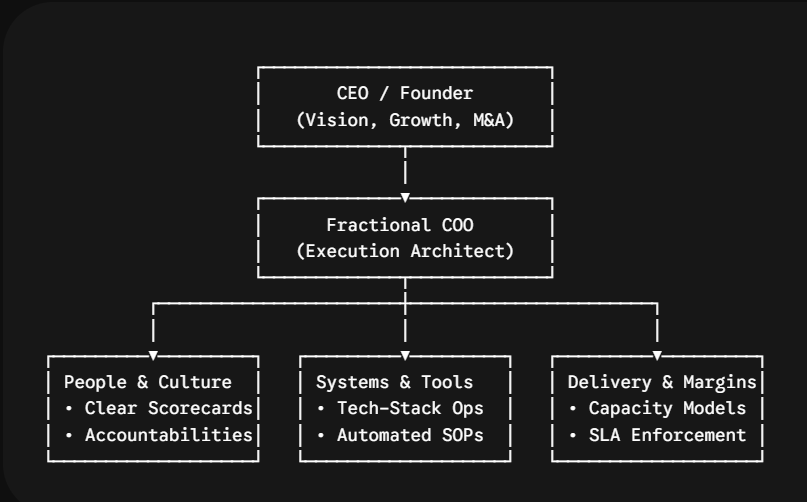
Rather than handing down strategic directives, a Fractional COO manages three core pillars of company performance:
Systems and Infrastructure Architecture
Growing businesses often run on an uncoordinated web of SaaS platforms: Asana or ClickUp for project tracking, Slack for real-time messaging, HubSpot or Salesforce for sales, and spreadsheets for capacity forecasting.
A Fractional COO designs, configures, and standardizes these tools to ensure data moves cleanly between departments. They build automated handoffs between business development and client delivery, eliminating dropped balls and internal miscommunications.
People, Culture, and Clear Scorecards
Operational friction is frequently a communication breakdown disguised as a process problem. A Fractional COO establishes clear operating cadences:
- Weekly Level 10 / Leadership alignment meetings
- Transparent Key Performance Indicators (KPIs) owned by individual leaders
- Clear accountability charts that eliminate structural role confusion
- Scalable performance reviews tied to objective operational outputs
Delivery Capacity and Margin Protection
As service businesses scale, project complexity increases, often eating away at profit margins. A Fractional COO analyzes billable utilization, client delivery velocity, and scope management. When scope creep threatens delivery margins, the Fractional COO renegotiates contractual guardrails and restructures delivery workflows to safeguard gross profitability.
The Four Critical Warning Signs You Need an Operator, Not an Advisor
How do founders determine whether they need high-level advisory or an embedded operator? If your organization exhibits two or more of the following symptoms, a strategy consultant will only add overhead to an already stressed engine:
1. The “Founder Bottleneck” Has Stalled Top-Line Growth
Every major internal question runs through the founder’s desk. You cannot step away for a week without deliverables stalling, client escalations multiplying, or decisions freezing. You already know your strategic direction—you simply lack the operational bandwidth to build an engine that runs independently.
2. Strategy Exists, but Execution Stalls Indefinitely
Your quarterly planning sessions produce comprehensive roadmaps, ambitious revenue targets, and critical operational initiatives. Yet at the end of each quarter, the same strategic priorities carry over unresolved because your core team was consumed by day-to-day client fires.
3. Departmental Silos Are Degrading Client Retention
Sales promises scopes that delivery teams struggle to fulfill; marketing generates leads that sales fails to qualify on time; operations blames finance for slow tooling approvals. When departments operate in isolation, client onboarding suffers, driving up early churn.
4. Headcount Grows Faster Than Net Profit
You continue to add payroll to manage client volume, but your net operating margins decline. This indicates operational inefficiencies, broken capacity planning, and duplicate efforts across your service delivery pipeline.

The Economics: Full-Time COO vs. Consultant vs. Fractional COO
For businesses generating between $2M and $20M in annual revenue, traditional leadership hiring models often fail basic cost-benefit analyses:
- Full-Time Chief Operating Officer: A vetted, tier-one COO demands a base compensation of $275,000 to $400,000+, plus executive benefits, annual bonuses, and 1% to 5% equity. For companies below $15M in revenue, committing to an executive compensation package of that scale can create significant overhead risk before operational systems are fully matured.
- Management Consulting Engagements: Top-tier management consulting firms charge retainers ranging from $50,000 to $150,000+ for a standard 8-to-12-week diagnostic audit. The contract concludes precisely when the client must figure out how to execute the findings internally.
- Fractional COO Engagement: An experienced Fractional COO provides elite C-suite leadership at a predictable investment of $6,000 to $15,000 per month. There is no long-term equity dilution, minimal executive overhead, and immediate focus on building workflows, mentoring staff, and driving accountability from week one.
Cost vs. Accountability Spectrum

Management Consultant ───────► High Fee / Low Execution Accountability
Full-Time COO         ───────► Maximum Fixed Overhead / High Equity Dilution
Fractional COO        ───────► Agile Investment / Direct Operational Ownership
How to Integrate a Fractional COO for Maximum ROI
Successfully onboarding a Fractional COO requires intentional positioning and clear authority boundaries. To maximize the impact of your operational partner, follow this proven integration framework:
Month 1: Diagnostic & Quick Wins   ──► Audit systems, eliminate urgent friction, establish baseline KPIs
Month 2: Core Workflow Engineering ──► Rebuild delivery pipelines, integrate tech stack, establish cadences
Month 3+: Optimization & Autonomy ──► Enforce accountability, mentor managers, free founder bandwidth
- Grant Legitimate Executive Authority: A Fractional COO cannot succeed if the team perceives them as an external contractor or auditor. The CEO must explicitly communicate to the entire company that the Fractional COO possesses operational decision-making authority over internal processes, tooling, and accountability cadences.
- Anchor the Engagement to Specific Operational Scorecards: Define clear, quantifiable success metrics before the engagement begins. Whether the priority is reducing project delivery cycles by 25%, establishing 80% billable team utilization, or automating client onboarding, clear scorecards keep the focus squarely on execution.
- Step Out of the Tactical Weeds: The ultimate return on investment from a Fractional COO is the return of the founder’s time. As your Fractional COO installs operating cadences and takes over departmental management, the founder must resist the urge to micromanage tactical decisions, redirecting their focus toward vision, product innovation, and enterprise client relationships.
Strategy Without Execution Is Overhead
Strategy determines your destination; execution dictates whether you survive the journey.
In a volatile, competitive market, growing organizations rarely fail due to a lack of strategic vision. They fail because the daily operational friction of execution drains their capital, burns out their talent, and keeps executive leadership trapped in firefighting mode.
When choosing between an external management consultant and a Fractional COO, the decision comes down to what your business requires right now: more theoretical ideas to evaluate, or an experienced operator to build and run the engine.
If your business is ready to eliminate operational bottlenecks, free up founder capacity, and establish an operational system built for predictable scale, hands-on execution will always outperform a static slide deck.
Turning Strategy into Measurable Scale
Strategy without execution is merely expensive overhead. While traditional management consultants deliver valuable diagnostics, advice alone cannot untangle delivery bottlenecks, streamline operational tech stacks, or protect profit margins when your service business is scaling rapidly. Sustainable growth requires an embedded operator who takes direct ownership of internal workflows, aligns delivery teams, and builds the infrastructure that allows the business to run independently of the founder.
If your leadership team is tired of high-level slide decks that collect digital dust and you are ready to install a proven operational engine that runs with precision, bringing in an experienced Fractional COO is the highest-leverage move you can make.
Schedule a strategic discovery session today to identify your operational bottlenecks and explore how a dedicated Fractional COO can unlock predictable, hands-on execution for your business.