

If you run a service business, you know the feeling. Your crew is slammed, the phones are ringing, and your schedule is packed out weeks in advance. You’re working 60-hour weeks, managing crews, handling client complaints, and putting out fires.
On paper, you’re crushing it. But when you check your bank balance at the end of the month, the reality hits hard: Where did all the money go?
You made payroll, paid the vendors, put gas in the trucks, and covered overhead. But after all that hustle, your actual profit is a fraction of what it should be for the amount of work you pulled off.
This is the hidden epidemic in service businesses—from roofing, HVAC, and plumbing contractors to medical spas and specialized clinics. You aren’t suffering from a lack of talent or work ethic. You’re suffering from a lack of operational visibility.
You are caught in the trap of “fake revenue”—taking on jobs that generate top-line cash flow but secretly drain your bottom-line profit.
To stop leaking money and start scaling predictably, you need a single operational tool: Job Costing.
What Is Job Costing (and Why Should You Care)?
At its core, job costing is the practice of tracking the exact revenue, direct expenses, labor costs, and overhead allocation tied to an individual job, project, or client.
Most service business owners look at their financials through a single, dangerous lens: The Overall Income Statement.
They see $100,000 come in during April and $82,000 go out in total expenses. They figure they made $18,000 in net profit, celebrate the good month, and keep pushing forward.
The problem? That overall number lies to you.
Inside that $100,000 month, here is what actually happened:
- Job A (Roof replacement): Generated $40,000 in revenue, cost $22,000 to deliver. Net profit: $18,000.
- Job B (Custom patio build): Generated $35,000 in revenue, cost $25,000 to deliver. Net profit: $10,000.
- Job C (Complex remodel): Generated $25,000 in revenue, cost $35,000 to deliver (due to labor overruns, extra trips, and scope creep). Net profit: -$10,000.
Without job costing, you look at your bank account and think all three jobs contributed to your business. In reality, Job C wiped out over 35% of the hard-earned profits from Job A and Job B. You essentially paid money out of your own pocket for the privilege of working yourself to exhaustion on Job C.
The Psychological Trap: Busy vs. Profitable

To understand why so many talented operators fall into this trap, we have to look at the psychology of human decision-making and business ownership.
Human beings are wired to prioritize immediate visual feedback over delayed analytical clarity. In business, busyness provides instant validation.
- Seeing 5 trucks rolling out of the yard every morning triggers a dopamine hit that feels like success.
- Sending out 15 quotes a week makes you feel productive.
- Deposits hitting the bank account gives a temporary sense of security.
However, revenue is a vanity metric. Profit is sanity.
When you don’t track job costing, your brain defaults to two cognitive biases:
The Sunk Cost Fallacy:
You spend an extra 15 hours fixing an issue on a job because “we’ve already come this far,” without calculating that those 15 hours just erased your entire profit margin.
The “Optimism Bias” in Bidding:
When quoting a new project, you estimate labor and materials based on the best-case scenario when everything goes right. But in field services, variables like bad weather, supply chain delays, client changes, and miscommunication happen routinely.
If you don’t track actual costs against estimated costs, you will keep bidding based on wishful thinking rather than historical reality.
The Four Silent Profit Leaks in Service Businesses
Where is the money actually going on the jobs that keep you busy without making you rich? Through four distinct profit leaks:
1. Uncollected Labor Overruns
Labor is the hardest cost to predict and the easiest to lose control of. If you estimate a job will take two technicians 8 hours (16 total labor hours), but unforeseen complications stretch it to 12 hours (24 total labor hours), your labor cost on that job just surged by 50%. If you billed a flat rate, that entire cost comes directly out of your net profit margin.
2. Invisible “Windshield Time” and Supply Runs
If your crew spends 45 minutes stuck in traffic traveling to a job site, or drives to the local supplier twice in one day because they didn’t have the right fittings on the truck, who pays for that time? If it isn’t baked into your job costing system, you do.
3. Unmanaged Scope Creep
“While you’re here, can you just take a look at this?” In service industries, customer service skills are crucial—but unmanaged scope creep is lethal. Doing “quick 15-minute favors” across three jobs a day costs you nearly 4 hours of unbilled labor every week per technician.
4. Misallocated Overhead
Direct costs (materials, subcontractor fees, technician wages) are relatively easy to see. Indirect costs (truck insurance, dispatch software, shop rent, office staff salaries) are trickier. If your job costing model doesn’t allocate a percentage of your fixed overhead into every single job, your “profitable” jobs are actually losing money once the real operational bill comes due.
Step-by-Step: How to Implement Job Costing in Your Business

Transitioning your business from reactive guessing to proactive job costing doesn’t require an accounting degree. It requires a repeatable framework and the right systems.
Step 1: Calculate Your True Fully Burdened Labor Rate
Never use an employee’s hourly wage as their cost to the business. A technician paid $25/hour costs far more than $25/hour once you account for employment taxes, worker’s compensation insurance, paid time off, benefits, and uniforms.

Example: A $25/hour employee who works 2,000 hours a year actually costs the company $37.50/hour in true burdened labor cost once overhead burdens are applied.
Step 2: Establish Direct Cost Tracking Per Job
Ensure every line item expense is tagged to a specific job number in your field management software (such as ServiceTitan, Jobber, or QuickBooks Online):
- Materials: Invoices from vendors tagged directly to the job ID.
- Subcontractors: Specialized labor billed to the project.
- Direct Equipment Rental: Scaffolding, dumpsters, or specialized tools rented specifically for that site.
Step 3: Implement Precise Time Tracking
Require field staff to clock into specific job tasks using mobile apps. Train your team to understand that time tracking isn’t about micromanagement it’s about accuracy. If a job type consistently takes 10 hours instead of the estimated 6 hours, you don’t need to fire the crew; you need to increase your price for that service on future bids.
Step 4: Add Overhead Allocation
Determine your business’s overhead percentage by dividing total annual overhead expenses by total annual revenue:

If your overhead is 20%, every job estimate must cover its direct materials, direct fully burdened labor, plus a 20% overhead allocation factor before adding your desired net profit margin.
How AI Agents and Automations Streamline Job Costing
Historically, service business owners avoided job costing because the manual data entry was overwhelming. Collecting paper receipts from truck dashboards, manually matching vendor invoices to job numbers, and manually typing timesheet data into spreadsheets took dozens of hours every week.
Today, modern field service automations and AI systems do this heavy lifting in real time:
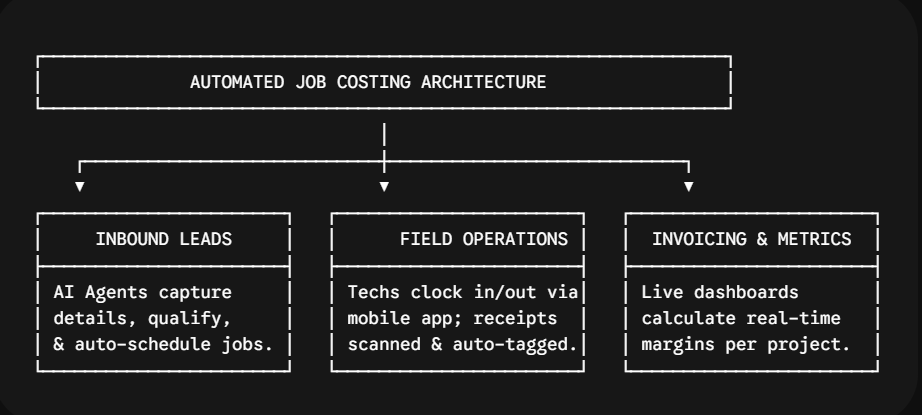
Automated Receipt Capture:
Field techs snap photos of supply receipts with their phones. OCR tools automatically scan the total, extract the items, and attach the cost directly to the active job file.
Real-Time Variance Alerts:
Operational dashboards compare estimated labor hours against live clock-ins. If a job hits 80% of its labor budget but is only 50% complete, system alerts notify management immediately allowing you to address scope issues before the job finishes, not weeks later.
Automated Lead Qualification:
By pairing job costing with 24/7 AI chat and phone agents, you ensure you only send crews out to high-margin, ideal jobs. AI agents pre-qualify inbound inquiries based on job type, scope, and location before they ever hit your schedule.
Shift Your Strategy: From Revenue Chasing to Margin Maximization

When you master job costing, your entire perspective on scaling changes:
You stop competing on price. You know your exact cost structure, giving you the confidence to hold your price ceiling while competitors race to the bottom.
You drop toxic clients and low-margin services. You can review a year of data, identify the 20% of job types that consume 80% of your admin time while delivering low margins, and eliminate them from your service catalog entirely.
You scale with peace of mind. Growth no longer means more chaos; it means replicating high-margin operations with total financial visibility.
If you are tired of working hard, keeping crews busy, and wondering why your profit margins don’t reflect your effort, it is time to look under the operational hood of your business.
Stop Leaking Profit in Your Operations
At Heart Craft Media, we specialize in helping small-to-medium service businesses stop profit leaks, automate their operations, and build predictable systems for growth.
Whether you need a Fractional COO to rebuild your job costing and bidding frameworks, AI Agents to capture and qualify leads 24/7, or a comprehensive Operations Audit to uncover where your business is silently losing money, we get in the trenches with you to fix what’s broken.
Book a free 30-Minute Operations Audit with Heart Craft Media today and get a clear, prioritized roadmap to make every job profitable.
Ready to see where your business is losing profit?