Every month, thousands of service-based businesses from roofers and HVAC technicians to medical practices and legal firms pour money into local SEO, Google Ads, and social media campaigns. Leads submit forms, request estimates, or call during peak hours. Yet despite high ad spend, pipeline growth stays flat.
The problem is rarely marketing quality. It is almost always operational friction: the delay between a lead submitting an inquiry and a business responding.
In modern service operations, response velocity dictates revenue capture. Here is a look at what the data reveals about speed-to-lead, the neurobiology of customer decision-making, and how high-growth businesses structure their operations to close the response gap.
Direct Answer Summary
What is the 5-Minute Speed-to-Lead Rule?
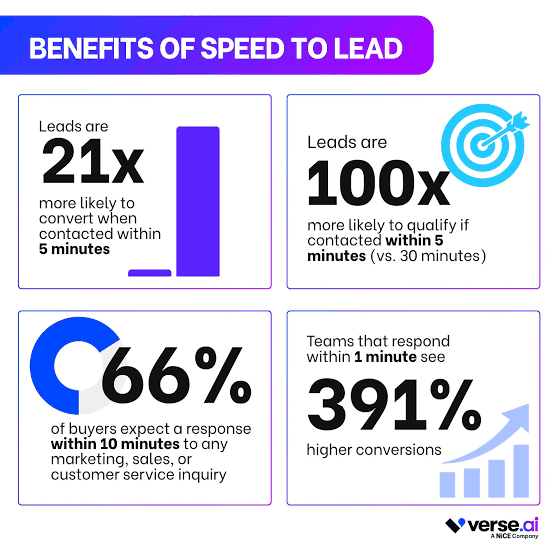
The 5-Minute Speed-to-Lead Rule dictates that businesses attempting to contact an inbound lead within five minutes of submission are 21 times more likely to qualify and 100 times more likely to reach that prospect compared to responding after 30 minutes. Responding within this timeframe directly leverages peak customer interest, prevents prospect deflection to competitors, and significantly increases close rates.
What Is “Speed to Lead” and Why Is It Critical?
Speed to lead is the total elapsed time from when a prospective client submits a digital form, sends a chat message, or calls an operational office to the moment a qualified representative or automated AI agent establishes direct two-way engagement.
In local service operations, leads are perishable assets. Whether a homeowner has a leaking roof or a prospective patient is searching for a local specialty practice, the moment of inquiry represents peak intent. Delaying follow-up decays that intent exponentially.
The Hard Statistics: Responding in 5 Minutes vs. 30+ Minutes
Decades of lead-response benchmark data (originally published by MIT and Harvard Business Review, and reinforced across modern CRM data studies) demonstrate a steep decay curve:
| Metric / Outcome | Within 5 Minutes | At 30 Minutes | Difference / Impact |
| Lead Qualification Rate | Peak Likelihood | 21x Lower | 2,100% drop in qualification efficiency |
| Successful Contact Rate | 100x Higher | Baseline | 100x reduction in connection probability |
| Lead Drop-off to Competitors | Minimal | ~78% | 78% of buyers purchase from the first responder |
| Conversion Expectation | 391% Boost (1-min mark) | Baseline | Significant drop after the 5-minute threshold |
1. The 100x Contact Multiplier
Reaching a lead within 5 minutes makes a business 100 times more likely to connect compared to reaching out at the 30-minute mark. By minute 30, the lead has frequently stepped away, resumed work, or contacted a competing service provider.
2. The 21x Qualification Multiplier
Once connected, prospects reached within 5 minutes are 21 times more likely to enter the qualification pipeline than those contacted after 30 minutes.
3. The “First-Responder Wins” Dynamic
Research shows that 78% of service-based purchases go to the business that responds first. In competitive trades and professional services, response velocity is often the deciding factor in securing the job.
The Human Factor: Neurological and Psychological Drivers
Understanding why response speed dictates conversion requires analyzing human cognitive behavior during a purchasing decision:
1. Dopamine, Intent, and Task Completion
When a consumer submits a lead form, their brain experiences a surge in focus and urgency driven by problem recognition. Reaching out while they remain in this state leverages their active intent. If 15–30 minutes pass, their attention shifts, and the psychological momentum resets. Re-engaging them later creates cognitive friction rather than a seamless solution.
2. Trust and Operational Competence
In service industries, consumers equate response speed with overall operational reliability. A two-minute response builds immediate trust, suggesting a organized, attentive business. A multi-hour or next-day response signals potential delays in execution, scheduling, or communication.
3. Anxiety Mitigation in Emergency & High-Ticket Services
For high-ticket service industries such as roofing, plumbing, healthcare, or legal consultations the purchasing decision is accompanied by stress. Rapid outreach immediately alleviates buyer anxiety, removing the urge to seek alternative options.
Why Small Service Businesses Struggle with Speed to Lead
Despite clear data, the average response time for small-to-midsized service businesses sits at over 47 hours, with nearly 55% of leads receiving no response at all.
The primary operational obstacles include:
- The “Owner-Operator Ceiling”: When key leaders are in the field, on job sites, or managing client work, inbound inquiries hit voicemail or sit in an unread inbox.
- Non-Standard Business Hours: Over 30% of high-intent service inquiries occur outside standard 8:00 AM – 5:00 PM business hours. Manual coverage during nights and weekends is costly and difficult to sustain.
- Fragmented Lead Channels: Leads flow through disparate touchpoints website forms, Google Business Profile messages, social media, and phone calls. Disconnected tools create triage delays.
- Manual Data Entry: Transferring lead information manually into a CRM before initiating outreach introduces systematic operational friction.
How AI Agents and Automation Solve Speed to Lead
Achieving sub-5-minute response times around the clock requires shifting from manual triage to automated systems architecture.
1. AI Voice & Chat Agents
Modern voice and conversational AI agents engage incoming calls and web inquiries instantly—24/7/365. Rather than sending leads to voicemail, AI agents qualify prospects, answer common questions, and capture critical job details in real time with zero latency.
2. Automated Instant Scheduling
Eliminate email and phone tag by integrating automated scheduling workflows. When a prospect submits an inquiry, an automated message provides immediate calendar access for booking an estimate or consultation.
3. Centralized Lead Triage Workflows
Connecting marketing channels directly into an automated CRM ensures that instant SMS and email notifications engage prospects within 30 seconds of submission, securing the “first-responder” advantage automatically.
Frequently Asked Questions
What qualifies as a “good” speed to lead in 2026?
Under 5 minutes is the industry standard for high conversion. However, top-performing service organizations using AI automation target under 60 seconds, which yields up to a 391% boost in conversion rates compared to delayed responses.
Is an automated auto-responder enough to satisfy the 5-minute rule?
No. A generic static email auto-responder (“We received your request and will get back to you in 24 hours”) does not satisfy customer intent. Speed to lead requires interactive, two-way engagement—such as conversational AI chat, an interactive booking link, or an immediate phone call.
How does speed to lead impact AI search optimization (GEO) and local SEO?
Search platforms like Google prioritize businesses with strong engagement metrics and rapid response indicators (e.g., Google Business Profile response badges). In generative AI search engines, business responsiveness and verified client interaction speeds factor directly into brand authority recommendations.
Next Steps for Your Operations
Fixing speed to lead is often the fastest way to increase top-line revenue without raising marketing budgets. Upgrading from manual follow-up to automated lead handling captures missing pipeline that is currently lost to competitors.
To evaluate your business’s current response velocity and locate operational gaps, request a comprehensive review of your setup.
24/7 AI Phone and Chat Agents act as an automated front desk that never sleeps, goes on break, or lets a call go to voicemail.
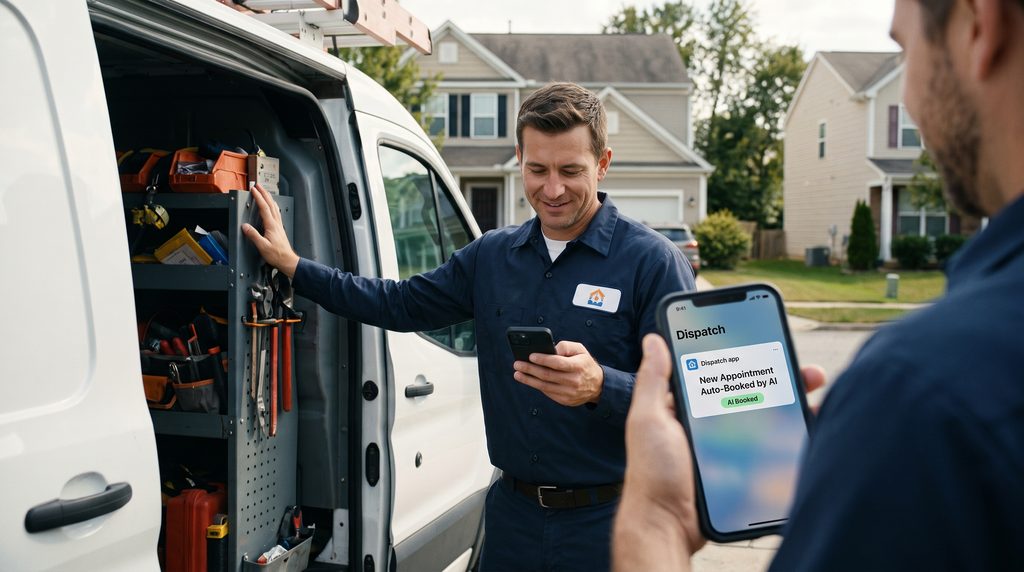
Unlike old-school phone menus (“Press 1 for Sales”) or basic website contact forms, modern AI agents run on conversational Natural Language Processing (NLP) and direct system integrations. They engage leads with human-like conversation across speech and text, gather necessary information, evaluate fit, and schedule appointments directly into your business calendar in under 60 seconds.
Step 1: Instant Multichannel Intake
The process triggers the second a prospective client reaches out:
- AI Phone Agent: Answers incoming phone calls on the first ring (or handles overflow/after-hours calls) using a natural, voice-synthesized speech model.
- AI Chat Agent: Initiates a live conversation on your website, Google Business Profile, SMS, or direct messaging channels as soon as a user submits a question or starts a chat.
Step 2: Intelligent Lead Qualification
Rather than sending every inquiry straight to your calendar or inbox, the AI follows your operational criteria to qualify the prospect:
- Service Area Check: Verifies the customer’s ZIP code or location to ensure they are within your service territory.
- Job Identification: Asks targeted questions to determine the scope of work (e.g., “Is this a roof leak repair or a full replacement?”, “Are you experiencing an acute water heater breakdown?”).
- Urgency & Budget/Timing: Gauges whether the customer needs emergency dispatch, an estimate next week, or general information.
Step 3: Direct Calendar & CRM Integration
Once qualified, the AI handles scheduling without back-and-forth email tag:
- Real-Time Availability: The AI queries your live calendar or dispatch software (e.g., ServiceTitan, Jobber, Housecall Pro, Google Calendar) to identify open windows.
- Rule Enforcement: Respects your specific operational rules—such as buffer times between appointments, drive times, job durations, and max bookings per day.
- Slot Lock: Proposes 2–3 suitable slots, confirms the client’s choice, holds the slot, and writes the booking into your schedule.
Step 4: Instant CRM Sync & Team Handoff
Behind the scenes, the AI processes the interaction into structured business data:
- CRM Record Creation: Creates or updates a contact card in your CRM with full name, phone number, address, qualified notes, and full conversation transcripts/call recordings.
- Automated Confirmations: Sends an instant SMS or email confirmation to the client with appointment details and a link to reschedule if necessary.
- Team Notification: Alerts your sales, field tech, or estimating team via SMS, Slack, or email with a full summary of the qualified lead.
Key Operational Benefits
- Zero Latency (Sub-60-Second Speed to Lead): Captures high-intent prospects before they call a competitor.
- 100% After-Hours Coverage: Converts late-night and weekend traffic into confirmed Monday morning bookings.
- Emergency Live Escalation: Programmed to recognize urgent high-ticket calls (e.g., major water damage, emergency HVAC outage) and immediately transfer the call live to an on-call manager’s cell phone.
- Elimination of Administrative Drift: Frees office staff from repetitive discovery calls so they can focus on high-value customer service and operations.