

When a service agency hits a growth plateau, the default reaction from founders is almost always predictable: buy more pipeline.
More cold outbound, a revamped paid ad campaign, a new sales hire, or another marketing agency retainer. The founder assumes that if revenue is stagnant, the top of the funnel must be dry.
Yet six months and $50,000 later, revenue remains flat, profit margins compress, and the team is burnt out.
What looked like a lead generation problem was actually an invisible, structural bottleneck: Operational Drag.
Understanding the difference between a pipeline shortage and an operational capacity ceiling is the single most critical diagnostic a service business founder can make. Pouring leads into an operationally broken business doesn’t produce growth—it accelerates churn, degrades service delivery, and exhausts your key talent.
Here is the exact diagnostic framework to determine whether your agency is truly stalled by lead generation or quietly suffocating under operational drag—and how to fix it before your margins evaporate.
The Growth Mirage: Why Founders Misdiagnose the Plateau
In service agencies (marketing, creative, IT consulting, software development, professional services), revenue growth is not linear with head count or lead volume. It moves in step functions.
Between $1M and $5M in annual revenue, agencies routinely encounter what operations experts call the Capacity Ceiling.
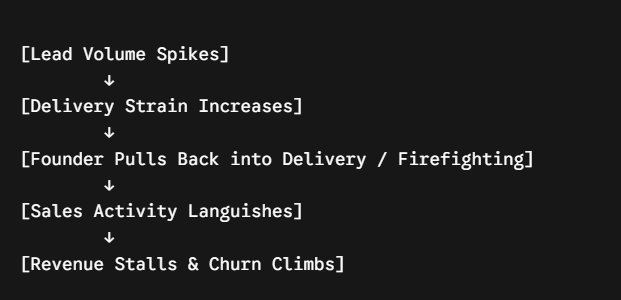
When an agency hits this ceiling, the founder feels an ambient sense of friction. Projects run late. Client onboarding slips. Deliverables require two rounds of internal rework before the client ever sees them. Senior staff spend 30% of their day answering Slack questions rather than doing deep work.
Because the pipeline eventually thins out while the team is buried in delivery fires, the founder misinterprets the symptom: “We need more deals.”
In reality, the agency’s subconscious operational immune system is rejecting new growth to prevent delivery collapse.
5 Telltale Signs Your Stalled Growth Is Operational Drag
If your agency exhibits three or more of the following patterns, your constraint is internal infrastructure, not market demand.
1. The “Whack-a-Mole” Founder Dependency Cycle
You spend the first two weeks of every quarter closing deals, only to spend the next ten weeks firefighting client delivery, resolving scope disputes, and QA’ing work.
If removing yourself from day-to-day client communications or project delivery causes quality to slip or clients to complain, your business does not have a scalable delivery engine. It has a founder-centric boutique service wrapped in agency packaging.
2. High Client Churn Shortly After Onboarding

Check your client retention cohorts. If clients exit between Month 3 and Month 6, your sales team is selling an expectation that your operations team is structurally unequipped to fulfill.
When lead gen is working but operations are dragging, onboarding is chaotic, project kickoffs are delayed, and early trust is destroyed. Buying more leads in this state simply converts marketing spend directly into client churn.
3. Margin Compression Despite Top-Line Growth
Compare your revenue growth to your net margin over the last 18 months. If gross revenue grew by 25% but net profit remained flat or declined, you are experiencing the compounding tax of operational drag.
Operational drag forces you to hire reactive, redundant headcount to solve workflow inefficiencies. Instead of building automated handoffs, documented SOPs, and clear resource allocation systems, you are throwing expensive human payroll at structural process leaks.
4. Utilization Rates Are High, but Realized Billables Are Low
Your team looks completely overwhelmed. They work late, complain about workload in 1-on-1s, and keep their status set to “Do Not Disturb.” Yet when you review effective hourly realization or project profitability, the numbers are dismal.
Where is the time going?
- Endless internal meetings to clarify ambiguous client briefs.
- Hunting down assets across siloed drives, Slack threads, and unorganized project boards.
- Scope creep that is never tracked, billed, or pushed back on.
- Rework caused by unclear quality control gates.
5. Sales Closes, Delivery Groans
When your sales pipeline actually delivers a dream client, what is the genuine emotional response from your team?
If landing a $15,000/month retainer is met with dread, panic, or quiet resentment by your delivery leads instead of excitement, your team knows instinctively that the operational chassis cannot support more weight.
Diagnostic Matrix: Lead Gen Bottleneck vs. Operational Drag
Use this comparative matrix to objectively evaluate where your agency’s primary point of failure sits:
| Diagnostic Metric | True Lead Gen Bottleneck | Operational Drag (Capacity Ceiling) |
| Close Rate on Qualified Pipeline | Remains steady (>25–30%), but raw volume of calls is insufficient. | Plummeting (<15%) because sales cycles drag, onboarding is vague, or case studies lag. |
| Team Capacity & Bandwidth | Delivery team has idle bandwidth; projects finish ahead of deadlines. | Delivery team is operating at >90% burn; overtime is chronic; burnout is rampant. |
| Client Retention (LTV) | High LTV (>18–24 months); retained clients are delighted and refer peers. | High early churn (first 90–180 days); NPS/CSAT drops as client roster expands. |
| Scope Management | Scope is strictly tracked and managed against contractual deliverables. | Massive unbilled scope creep; team regularly delivers extras “just to keep the client happy.” |
| Founder Daily Activity | 60%+ time spent actively prospecting, networking, and taking pitches. | 70%+ time spent in Slack, reviewing drafts, resolving client escalations, or managing tasks. |
| Process Standardization | Documented workflows exist and are followed systematically. | Processes live inside key employees’ heads; knowledge is siloed and non-transferable. |
The Hidden Cost: How Operational Drag Destroys Unit Economics
Most founders evaluate operational friction as an annoyance rather than a financial hemorrhage. Consider the compounding math:
Assume an agency billing $200,000/month ($2.4M ARR) operates with a typical 5-team delivery structure. Due to poor handoffs, lack of standardized scoping, and tool bloat, each team member loses an estimated 6 hours per week to non-value-additive drag:
- 30 lost hours per week across delivery leads.
- At a blended cost of $65/hour, that represents $101,400 per year in unrecoverable operational waste.
- Add to this the cost of a single lost $8,000/month retainer due to onboarding friction: $96,000 in lost annual recurring revenue.
- Add the cost of replacing an account manager who burns out and leaves: ~$35,000 in recruitment and ramp-up lag.
That is over $230,000 drained annually from net profit—not because the market didn’t want the service, but because the delivery architecture couldn’t sustain it cleanly.
4 Strategic Fixes to Break Through the Capacity Ceiling
If the diagnostic reveals that operational drag is capping your agency, pausing ad spend and focusing on your internal operating system is the fastest route to expanding net margins.
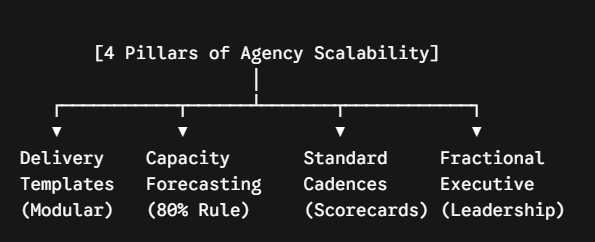
1. Transition from Bespoke Execution to Productized Delivery
Every custom deliverable created from scratch requires bespoke project management, bespoke QA, and bespoke client expectation setting.
Audit your last 10 client deliverables. Strip away custom variances and identify the repeatable 80%. Package your core delivery into modular, standardized production phases with locked input requirements. If a client does not provide the required creative brief or technical access by Day 3, the project timeline automatically shifts. Boundaries preserve delivery margins.
2. Implement True Resource Forecasting (The 80% Rule)
High-performing agencies never book their delivery talent past 80% of total capacity.
The remaining 20% is not wasted time; it is the buffer required to absorb client feedback, unexpected technical hurdles, training, and strategic internal improvements. When your team is scheduled at 100% capacity, a single minor delay cascades across every account, triggering operational drag across the entire agency.
3. Establish Clear Async Scorecards and Handoff Gates
Eliminate “status update” meetings. Implement an asynchronous project management architecture (ClickUp, Asana, or Monday.com) tied to rigorous Definition of Done (DoD) gates:
- What must be true before a project moves from Strategy to Execution?
- What specific checklist must be signed off before an asset reaches client review?
- Who owns the final margin accountability on this account?
When accountability is unambiguous, founder intervention becomes obsolete.
4. Deploy Fractional Operational Leadership
The traditional agency playbook suggests hiring a full-time Chief Operating Officer (COO) when growth stalls. However, an experienced executive COO demands $220,000 to $300,000+ base salary plus equity—a cost heavy enough to crush cash flow for agencies under $5M ARR.
This is precisely where a Fractional COO changes the equation.
A Fractional COO steps into your service business on a part-time or retainer basis to:
- Re-architect your agency’s operational infrastructure without permanent executive overhead.
- Install clear capacity planning, margin tracking, and delivery frameworks.
- Remove the founder from day-to-day delivery fires and client triage.
- Build scalable systems that allow new sales to drop directly to the bottom line.
The Path Forward: Scale the Foundation First
More leads will not fix a leaky bucket. If your service business is struggling to push past its current revenue plateau, step away from your ad accounts and audit your operational architecture.
Fixing operational drag expands gross margins, protects your team from attrition, elevates your client outcomes, and gives you back your sanity as a founder.
Once your capacity ceiling is dismantled, turning the lead generation engine back on will do what it was always intended to do: produce clean, sustainable, and highly profitable scale.