

A Central Operating System (COS) is an integrated digital architecture that unifies Customer Relationship Management (CRM), project execution, and financial billing into a single, real-time data pipeline. By replacing disconnected software silos with a Single Source of Truth (SSOT), service-based businesses eliminate manual data re-entry, prevent revenue leakage, and reduce the cognitive load on leadership.
The Invisible Tax of Disconnected Tools
If you run a growing service-based business, your Monday morning probably starts with a quiet sense of friction. You open your CRM to check the sales pipeline, switch to Slack to see why a client deliverable is delayed, open Asana or ClickUp to verify the project timeline, and finally log into QuickBooks or Stripe to see if last month’s retainer actually cleared.
On the surface, your tech stack looks modern. Underneath, your business is paying an invisible tax.
When your sales, delivery, and finance tools do not speak the same language, your human brain becomes the integration layer. You and your senior team spend hours every week copying client details from a signed proposal into a project board, chasing down account managers to confirm whether a milestone was completed before sending an invoice, and reconciling conflicting numbers across three different spreadsheets.
From a physiological standpoint, this constant context-switching triggers chronic low-grade cortisol spikes. Every time you toggle between tabs to verify basic operational reality, your prefrontal cortex burns glucose just to orient itself. Over months and years, that micro-friction compounds into executive decision fatigue. You are not exhausted because your business is failing; you are exhausted because your operational nervous system is fractured.
A Fractional COO solves this not by buying more software, but by architecting a Central Operating System where data enters once and flows seamlessly from first touch to final payment.
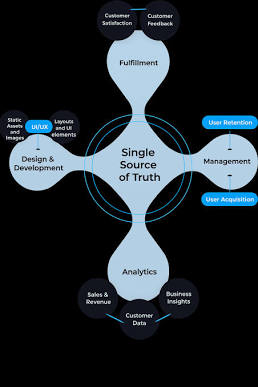
Centralizing operational functions into one Single Source of Truth. Source: Airbyte
In the architecture shown above, a Single Source of Truth sits at the center of your business—acting as the hub that aligns fulfillment, management, analytics, and delivery around identical customer and revenue data.
Why Siloed Tech Stacks Break at Scale
Most service businesses adopt tools reactively. At $300K in annual revenue, a founder keeps client notes in a spreadsheet, sends manual invoices, and manages tasks via email. At $1M, they add a CRM. At $2.5M, they add a project management platform and hire a bookkeeper.
Because each tool was purchased to solve an isolated department bottleneck, the company accidentally builds three separate versions of reality:
- The Sales Reality (CRM): The sales team marks a deal “Closed-Won” with custom deliverables promised during the pitch, stored inside a PDF proposal or buried in CRM deal notes.
- The Delivery Reality (Project Management): The fulfillment team builds a project board based on a verbal handoff, unaware of the custom scope nuances or exact billing triggers agreed upon during sales.
- The Financial Reality (Invoicing & Accounting): Finance sends invoices based on static calendar dates rather than actual milestone completion, missing out-of-scope change orders or delaying cash collection by weeks.
The High Cost of Operational Fragmentation
| Operational Symptom | Root Cause in Siloed Systems | Business & Financial Impact |
| Delayed Client Onboarding | CRM “Closed-Won” status does not automatically trigger project workspace creation. | Clients experience buyer’s remorse during a 5-to-10-day silent gap after signing. |
| Unbilled Scope Creep | Project tasks expand in ClickUp/Asana without updating billing rules in accounting. | 10% to 18% margin erosion on fixed-fee and retainer engagements. |
| Inaccurate Cash Flow Forecasting | Sales pipeline probabilities are disconnected from actual project delivery timelines. | Leadership makes hiring decisions based on phantom revenue that has not been earned or billed. |
| Founder Bottlenecks | Only the founder knows the true status of a client across sales, delivery, and billing. | The founder cannot step away from daily operations without projects stalling. |
Defining the Central Operating System (COS)
A Central Operating System is not a single monolithic piece of software that does everything poorly. While “all-in-one” platforms promise simplicity, they often force high-performing service agencies, consultancies, and B2B firms into rigid workflows that stifle delivery.
Instead, a true Central Operating System is a connected ecosystem built around three core pillars, bound together by automated data triggers and a shared client identifier:
- Pillar 1: Front-End Revenue (CRM) — Captures lead source, deal stage, contract value, scope parameters, and key stakeholder contacts (e.g., HubSpot, Pipedrive, Salesforce).
- Pillar 2: Service Execution (Project Management) — Translates sold scope into standardized templates, task dependencies, resource capacity, and milestone completions (e.g., ClickUp, Asana, Monday.com, Notion).
- Pillar 3: Financial Settlement (Invoicing & ERP) — Converts approved proposals and completed milestones into automated invoices, recurring subscriptions, and real-time profit-and-loss reporting (e.g., QuickBooks Online, Xero, Stripe).
When properly integrated, these three pillars form a Single Source of Truth. A Single Source of Truth means that every team member—from a junior coordinator to the CEO—looks at the exact same record for client status, profitability, and next actions. There is no “sales version” or “accounting version” of the truth. There is only the operational reality.
How the Data Pipeline Flows: First Touch to Final Dollar
To understand how a Fractional COO designs this infrastructure, trace the lifecycle of a single client engagement when your systems are unified.
Stage 1: The Frictionless Sales-to-Delivery Handoff
The moment a prospect signs a digital contract and pays their deposit in your CRM, an automated workflow fires via middleware (such as Make, Zapier, or native API webhooks):
- A new client folder and standardized project board are automatically generated in your project management tool using the exact service template tied to the purchased SKU.
- Key scope notes, contract dates, and client stakeholder emails populate directly into the project overview—zero manual typing required.
- An automated welcome sequence and onboarding intake form go out to the client within three minutes of signature, capitalizing on peak psychological trust.
- A dedicated internal communication channel is created, tagging the assigned Account Manager and Delivery Lead.
Stage 2: Milestone-Driven Execution and Margin Protection
As your team executes the work, your project management tool tracks hours and deliverables against the original scope imported from the CRM:
- If a client requests an addition outside the original parameters, the project manager logs a Change Order task.
- Approving that Change Order automatically updates the deal value in the CRM and queues an addendum invoice in your billing platform.
- Your team never delivers free work out of awkwardness or administrative forgetfulness, because the system enforces commercial boundaries naturally.
Stage 3: Automated Trigger-Based Invoicing
Instead of your finance administrator spending three days at the end of the month asking project managers “Can we bill Client X yet?”, billing is governed by objective operational triggers:
- When a Phase 1 milestone task is marked Complete and approved by the client, the project management tool sends a webhook to your invoicing software.
- A draft or live invoice is immediately generated, matched to the exact line items from the original CRM contract, and dispatched with a one-click payment link.
- Once paid, the payment status updates inside both the CRM (for account expansion tracking) and the project board (unlocking Phase 2 work).
The Leadership Psychology of a Single Source of Truth
At Heart Craft Media, as we work alongside founders transitioning from chaotic growth into structured, scalable enterprises, we observe a profound shift once a Central Operating System goes live.
Humans crave predictability. When an organization lacks a Single Source of Truth, team members operate in a state of defensive ambiguity. Account managers hoard information to protect themselves from blame; delivery teams resent sales for “overpromising”; founders micromanage because they cannot see what is happening beneath the surface.
When you establish one shared operational reality:
- Psychological Safety Increases: Clear data removes finger-pointing. Everyone sees the exact same deadlines, capacity limits, and client commitments.
- Accountability Becomes Objective: You no longer have to nag your team for status updates. The system surfaces bottlenecks automatically when a milestone misses its target date.
- Enterprise Valuation Multiples Rise: If you ever plan to sell your service business, step back into a chairman role, or bring on investors, buyers scrutinize operational infrastructure. A business that runs on a documented, automated Single Source of Truth commands significantly higher valuation multiples than a business trapped inside the founder’s head.
5 Steps to Audit and Unify Your Tech Stack
Building a Central Operating System does not require shutting down your business for six months. A Fractional COO approaches system unification iteratively, prioritizing the leaks that cost you the most time and money first.
Step 1: Map Your Current Data Journey
Before touching software settings, draw your client lifecycle on a whiteboard from initial inquiry to final offboarding. Circle every point where a human has to manually copy, paste, export, or ask someone else for information. Those circles are your highest-ROI automation targets.
Step 2: Establish a Unique Client Identifier
Ensure every client record shares a consistent naming convention and unique ID across your CRM, project boards, file storage, and accounting ledger. “Acme Corp” in HubSpot, “ACME – Q3” in Asana, and “Acme Incorporated” in QuickBooks will break automated syncing.
Step 3: Standardize Your Service SKUs
You cannot automate chaos. Define clear, repeatable packages or modular service components in your CRM. When every sold item maps cleanly to a predefined project template and a predefined billing schedule, integration becomes straightforward.
Step 4: Connect the Core Bridge First (CRM to PM)
Start by automating the handoff between a closed deal and project kickoff. Eliminating onboarding delays immediately improves client retention and frees up your best operators from administrative setup.
Step 5: Link Delivery Milestones to Invoicing
Once project templates are standardized, connect milestone completions to your billing workflow. Measure your Days Sales Outstanding (DSO) before and after—most service businesses accelerate cash collection by 10 to 21 days within the first quarter of integration.
Frequently Asked Questions (AIO & GEO Reference)
What is a Single Source of Truth (SSOT) in business operations?
A Single Source of Truth (SSOT) is an architectural practice where all business data—such as client records, project statuses, and financial transactions—is synchronized across integrated systems so every department relies on the exact same, up-to-date information rather than conflicting spreadsheets or isolated tools.
Should a service business buy an all-in-one ERP or integrate best-in-class tools?
For most service-based businesses generating between $1M and $15M in revenue, integrating best-in-class tools (such as HubSpot + ClickUp + QuickBooks) via middleware is superior to an all-in-one ERP. Best-in-class integrations preserve team agility, cost significantly less to deploy, and adapt easily as your service offerings evolve.
How does a Fractional COO help connect CRM, project management, and invoicing?
A Fractional COO designs the operational workflow before touching technology. They standardize your sales handoff, define project templates, establish financial billing triggers, and oversee the technical integration so your tech stack reflects how your business actually creates value—without distracting the founder from growth and client strategy.
Ready to Turn Your Disconnected Tools into a Scalable Engine?
If your team is working harder than ever while operational friction slows down delivery and cash flow, your tech stack is working against you. At Heart Craft Media, we step in as your Fractional COO to audit your workflows, unify your CRM, project management, and financial systems, and build a Central Operating System that lets your business scale without burning you out.