

Every founder remembers the moment their service business stopped feeling like an exciting challenge and started feeling like a trap.
In the early stages, hustle fixes everything. If a project is running late, you stay up late to finish it. If a client is unhappy, you step in personally to smooth things over. If cash flow is tight, you sell another engagement.
Then you scale. You cross seven figures. You hire talented specialists, bring on account managers, and sign more retainers than ever before. Yet instead of gaining freedom and seeing margins expand, you find yourself answering 70 Slack messages a day, resolving petty cross-functional disputes, untangling delivery bottlenecks, and putting out operational fires until 9:00 PM.
You have built a successful business, but you have accidentally turned yourself into its single biggest bottleneck.
When service business owners hit this ceiling, the gut reaction is usually to look for a Chief Operating Officer (COO). But operational leadership is a major organizational pivot. Hire too early or commit to the wrong model, and you burn hundreds of thousands of dollars on executive overhead you cannot support. Wait too long, and client churn, employee burnout, and margin erosion will quietly dismantle what you spent years building.
Here is an objective, ground-level breakdown of the revenue benchmarks, headcount triggers, and behavioral red flags that tell you exactly when to bring in senior operational leadership—and how to decide between a full-time hire and a Fractional COO.
The Operational Reality of Service-Based Growth
Unlike SaaS companies or e-commerce brands that scale by adding server capacity or manufacturing volume, professional service businesses scale through human beings, communication loops, and delivery frameworks.
Every client you add multiplies operational complexity:
- More deliverables to track across disparate tools.
- More client expectations to manage and align.
- More handoffs between sales, onboarding, fulfillment, and invoicing.
- More personnel requiring onboarding, performance management, and cultural alignment.
When a service business relies entirely on informal coordination, it can survive up to a certain threshold. Past that point, complexity compounds exponentially. If you do not have an operational architect whose sole focus is designing and maintaining your operating system, execution collapses under its own weight.
1. Concrete Revenue Benchmarks: When Does the Math Make Sense?
While organizational maturity is not determined by revenue alone, your top-line revenue establishes your risk tolerance and operational budget.
$0 to $1M ARR          $1M to $3M ARR          $3M to $10M ARR         $10M+ ARR
[Founder-Led Ops] ---> [The Founder Trap]  ---> [The Scale Plateau] ---> [Enterprise Tier]
Lead Ops/Project Mgr   Fractional COO Ideal    Fractional or Full-Time   Full-Time Executive
Under $1M Annual Recurring Revenue (ARR): The Building Phase
- Operational Reality: At this stage, your business is searching for repeatable market fit, standardized service packages, and reliable client acquisition.
- The Leadership Need: You do not need an executive COO. You need an agile Project Manager, an Operations Coordinator, or an Executive Assistant who can manage calendar mechanics, client onboarding checklists, and basic task management. Bringing in a six-figure operations executive here drains cash reserves without providing enough strategic scope to justify their salary.
$1.5M to $3M ARR: The Founder Trap
- Operational Reality: This is the most dangerous plateau for service companies. You have validated your offering and demand is high, but the wheels are wobbling. Margin leakage begins to creep in.
- The Leadership Need: You urgently need strategic operations leadership, but the business usually cannot justify a full-time executive salary ($180,000–$250,000+ base plus benefits and equity). This is the primary window where an embedded Fractional COO delivers the highest return on investment: establishing systems, KPIs, and team structures without bloating overhead.
$3M to $10M ARR: The Scale Plateau
- Operational Reality: At this tier, informal processes become completely untenable. Service delivery failures cost tens of thousands in lost client retainers. Departmental silos begin to form between sales, client success, and fulfillment.
- The Leadership Need: A dedicated operations executive is non-negotiable. Depending on margin health and complexity, companies at this stage either bring in an experienced Fractional COO for a 6–12 month operational overhaul or initiate a search for their first permanent, full-time COO.
$10M+ ARR: Enterprise Execution
- Operational Reality: The organization requires multi-layered operational governance, enterprise risk management, advanced resource forecasting, and departmental directors.
- The Leadership Need: A full-time, permanent Chief Operating Officer integrated into long-term equity and compensation structures.
Headcount Triggers: The Dunbar Breakdown in Service Teams
Revenue numbers only tell half the story. Headcount dictates human complexity. In professional services (agencies, consulting firms, IT managed services, accounting, legal, and specialized advisory), communication breaks down at predictable personnel milestones.
The 8-to-12 Person Inflection Point
When your internal team sits under seven people, everyone hears every conversation. Culture is absorbed through osmosis, and quality control happens organically because the founder reviews almost everything before it leaves the door.
Once you cross 8 to 12 team members, informal communication channels fail. The number of individual communication lines between team members skyrockets ($n(n-1)/2$). Without dedicated operational oversight, instructions get misinterpreted, client handoffs are fumbled, and the founder spends half their week clarifying tasks that used to happen automatically.
The 20-to-25 Person Breaking Point
At 20+ people, you no longer run a “scrappy crew”; you run an enterprise with distinct functions. At this threshold:
- You have multiple layers of delivery specialists who have never had a direct one-on-one strategy meeting with the CEO.
- Middle managers need mentoring, standard operating procedures (SOPs), and accountability scorecards.
- Department heads start optimizing for their own teams rather than overall company profitability.
If you reach 20 team members without an operational leader running delivery rhythms, margins will steadily compress even as top-line revenue increases.
3. The 7 Behavioral Red Flags: How Your Business Tells You It Needs a COO
If you are evaluating whether it is time to make a move, examine your day-to-day operations. These seven red flags indicate that operational debt has reached critical mass:
1. The Founder is the Chief Firefighter
If your daily calendar is dictated by reactive Slack pings, escalated client complaints, and internal delivery questions, your business does not have an operating system. When the CEO spends more than 30% of their week unblocking delivery teams, long-term strategic growth stalls.
2. Revenue Grows, but Profit Margins Shrink (The Leaky Bucket)
You sign 25% more client business this year, but net profit at year-end remains flat—or decreases. This is the classic symptom of unmanaged operational friction: scope creep, unbilled out-of-scope work, redundant software subscriptions, inefficient staffing allocations, and rework caused by poor quality control.
3. Departmental Silos and Cross-Functional Finger-Pointing
When a project deadline is missed or a client is unhappy, who takes ownership? If sales blames delivery for poor execution, and delivery blames sales for setting unrealistic expectations, you lack unified operational governance. A COO eliminates finger-pointing by engineering clear service-level handoffs and holding leaders mutually accountable.
4. Client Onboarding and Delivery Inconsistency
Client experience swings wildly based on which account manager or specialist handles the account. Client A receives an exceptional experience, while Client B experiences delays and misaligned deliverables. When delivery excellence depends on the individual heroics of a specific employee rather than a repeatable system, your business is unscalable.
5. Strategy Gets Discussed, but Never Implemented
You hold quarterly leadership offsites, identify critical internal initiatives (e.g., updating the tech stack, rolling out client retention sequences, implementing performance scorecards), and document them in project boards. Three months later, nothing has changed because everyone is buried in day-to-day client work. A COO bridges the gap between high-level vision and tactical execution.
6. Decisions Stall Without Founder Approval
If your team cannot resolve a billing dispute, approve a scope modification, or reallocate project resources without bringing it to your desk, you have created a culture of permission rather than a system of accountability. This creates immense decision fatigue for the founder and slows company response times down to a crawl.
7. Key Person Vulnerability and Tribal Knowledge
Critical business processes exist only in the heads of two or three long-tenured employees. If a senior lead took an unexpected three-week leave of absence, would client fulfillment continue seamlessly, or would operations freeze? An operations executive turns tribal knowledge into documented, institutional assets.
4. Full-Time COO vs. Fractional COO: Which Route Fits Your Stage?
Recognizing the need for operational leadership is only half the battle; choosing the right vehicle is what protects your balance sheet. Service businesses between $1.5M and $5M in revenue frequently make the mistake of hiring a traditional full-time executive before their systems are ready to support one.
| Evaluation Factor | Full-Time Chief Operating Officer | Embedded Fractional COO |
| Annual Financial Commitment | $180,000 – $275,000+ base salary | Flat monthly retainer (e.g., $6,000 – $9,000/mo) |
| Additional Overhead | Benefits, payroll taxes, bonuses, equity dilution (adds 25–35%) | Zero overhead, no equity, fully deductible expense |
| Search & Onboarding Time | 3 to 6 months to recruit, vet, and hire | Immediate deployment (within 1 to 2 weeks) |
| Time to Measurable Impact | 90 to 180 days to ramp up and evaluate | Identifies bottlenecks and installs fixes within 30 days |
| Contractual Flexibility | Long-term employment agreement, severance liabilities | Month-to-month or flexible scoped engagement |
| Primary Sweet Spot | $5M – $10M+ ARR with 30+ team members | $1.5M – $5M ARR scaling teams navigating bottlenecks |
Why Service Companies Leverage the Fractional Model First
- Zero Long-Term Risk: An executive bad hire at the C-suite level can set a growing service business back 18 months in lost momentum and severance costs. A Fractional COO allows you to bring elite, veteran operational acumen inside your business immediately without long-term commitments.
- Architecture Before Maintenance: Most $1M–$5M businesses do not actually need someone sitting in a full-time seat 40 hours a week just to maintain existing operations. They need an architect to come in, audit workflow bottlenecks, build automated delivery funnels, design accountability frameworks, and train the existing team. Once that infrastructure is built, daily operations run efficiently with existing managers.
- Outside Perspective and Pattern Recognition: An operator who has managed operations across multiple service businesses brings cross-industry pattern recognition. They have seen how dozens of agencies, IT providers, and consultancies solved the exact bottlenecks you are currently facing for the first time.
The Path Forward: Assessing Your Readiness
If your service company is generating healthy top-line revenue but you are personally exhausted, client delivery feels fragile, and strategic plans are perpetually postponed, your business does not have a sales problem. It has an operations problem.
Hiring your first operational leader is not an admission of failure; it is the natural transition from a founder-dependent business to a scalable, resilient enterprise.
Whether your next step is a targeted 30-day operational reset, bringing in an embedded Fractional COO to reconstruct your workflows, or mapping out your first executive recruitment profile, waiting until things break completely is the most expensive mistake you can make.
The right operational partner will pay for themselves by plugging margin leaks, unlocking executive capacity, and building an engine that delivers results consistently whether you are in the room or not.
Operational Bottleneck & Fractional COO Readiness Scorecard
When service businesses stall between $1M and $5M in revenue, the issue is almost never demand or talent—it is operational friction. This self-assessment diagnoses where your business is losing margin, time, and focus, and calculates your exact Operational Bottleneck Score.
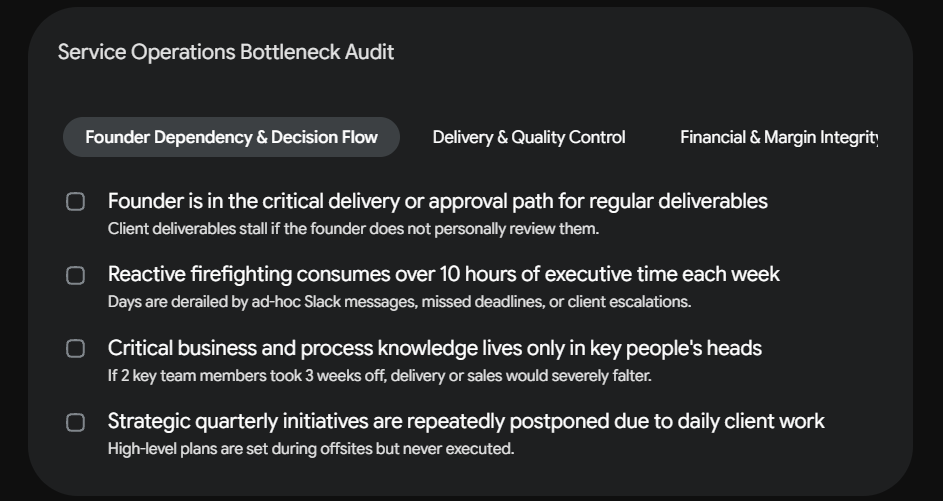
Part 1: The Bottleneck Audit Checklist
Use this interactive tracker to audit your systems across the four core operational engines. Check each statement that is currently true for your business.
Part 2: Interactive Bottleneck & ROI Calculator
Evaluate your operational drag quantitatively. Use the calculator below to input your company metrics, calculate your operational drag cost, and see the financial impact of deploying an embedded Fractional COO versus hiring full-time or maintaining the status quo.
Part 3: Interpreting Your Bottleneck Score
Count the total number of items checked in the audit above:
Score 0 – 3: Scalable Foundation (Low Operational Drag)
- Diagnosis: Your core operating workflows are stable. Decisions flow smoothly without your direct intervention on every project.
- Prescription: You do not need a senior operations executive right now. Focus on standardizing micro-SOPs, automating remaining handoffs with lightweight webhooks/APIs, and supporting your existing delivery leads.
Score 4 – 7: The Founder Friction Zone (Moderate Drag)
- Diagnosis: You have reached the $1.5M–$3M inflection point. You are still hitting revenue targets, but the operational tax is growing: client delivery varies by account lead, margins are eroding around the edges, and the leadership team is caught up in reactive problem-solving.
- Prescription: This is the ideal window for an embedded Fractional COO or a 30-Day Operations Reset. Installing standardized workflows, clear accountability scorecards, and capacity modeling now will prevent costly structural failure as you scale toward $5M.
Score 8 – 12: High Operational Crisis (Severe Bottleneck)
- Diagnosis: The founder is currently the primary bottleneck of the business. You are paying a triple penalty: lost strategic revenue, margin leakage, and employee churn. Strategic expansion is stalled because the company cannot handle further volume without execution breaking down.
- Prescription: Immediate operational intervention is required. You need an experienced executive to enter the business, audit profit leaks, unblock team leads, install clear SLAs between sales and fulfillment, and take day-to-day operations off the founder’s desk.